
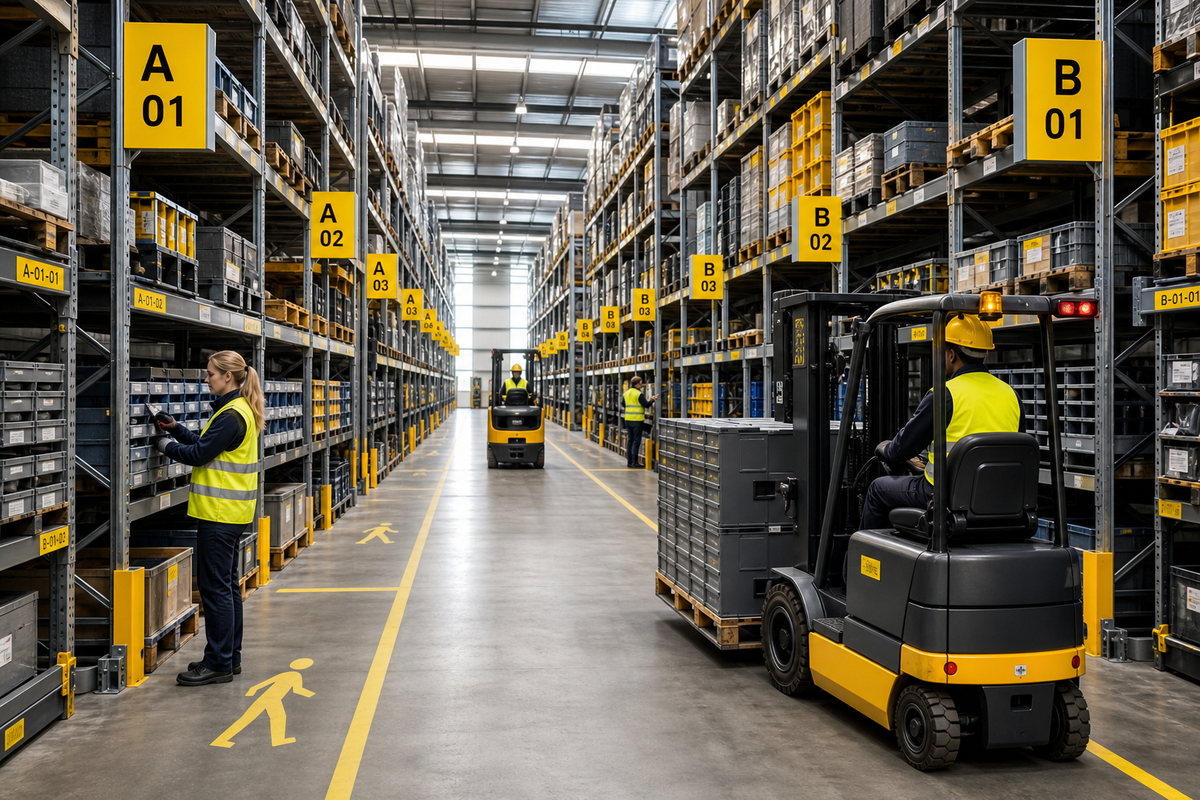
When forklift operators go to rack row 14 to look for the container with item number 7842 and instead find an illegible label strip, the resulting costs quickly add up. Misplacements, extended travel times, and inventory discrepancies are not isolated incidents in corporate warehouses with several thousand storage locations. This guide shows you how to establish a standardized storage location labeling system that measurably improves inventory visibility, orientation, and process reliability in multi-tier warehouse structures.
The focus is on corporate warehouses in Germany, where different locations, ERP systems, and material flows converge. You’ll learn which coordinate systems have proven effective, which materials can withstand industrial stresses, and how rack labeling and container labeling can be combined into a unified system. ORGATEX provides you with tried-and-true methods that deliver results directly at the point of value creation.
What does storage location labeling mean in a corporate warehouse?
Storage location labeling describes the systematic labeling and visual marking of all storage locations, shelf levels, containers, and floor zones in a warehouse. In a corporate setting, the requirements extend beyond a single warehouse: multiple locations must operate according to the same rules so that goods movements, inventory data, and shift handoffs function smoothly.
Without a standardized system, each location develops its own naming conventions. The practical consequence: When goods are transferred between two plants, the storage location designations in the ERP system do not match the physical labeling. This leads to an increase in posting errors and the time spent searching for items.
Why is storage location labeling particularly challenging in corporate warehouses?
In a single-site warehouse, a simple labeling concept is often sufficient. In a corporate environment with 5, 10, or 20 locations, this simplification faces a different reality: Different ERP systems, established shelving structures, and location-specific practices create a patchwork of naming conventions.
If Plant A labels its shelf rows with letters and Plant B with numbers, central inventory management cannot reliably consolidate the data. When transfers occur between locations, incorrect entries are created that only become apparent during the next inventory count.
In addition, physical conditions vary: A temperature-controlled high-precision warehouse places different demands on label materials than an outdoor warehouse exposed to the elements or a high-rack warehouse with heavy forklift traffic. This variability requires a labeling concept that establishes a uniform standard while also allowing for flexible material combinations to accommodate different environmental conditions.
Why do labeling projects fail in multi-tiered warehouse structures?
Many corporate warehouses start out using labels printed on office printers. These makeshift solutions cannot withstand forklift impacts or oil-laden air. After just a few weeks, barcodes become unreadable, color codes fade, and storage location labels are barely legible.
A second common pattern: Each location develops its own system. Plant A numbers by aisles, Plant B by shelf rows. According to a technical article on industrie-fachwissen.de, a lack of standardization in shelf addressing leads to higher error rates during cross-site transfers. This makes group-wide inventory transparency impossible.
A third factor is a lack of maintenance. Labels are applied once and then never updated. When the warehouse layout changes, old labels remain in place while new ones are missing. The result: employees no longer trust the labels and rely instead on the experiential knowledge of individual colleagues.
What elements are part of a comprehensive labeling system?
Shelf Row and Aisle Labeling
Large signs at the ends of the shelving rows provide the first level of orientation. They display the shelving row number and are legible from several meters away. Triangular shelving and aisle signs further increase visibility because they are visible from both sides of the aisle.
Shelf Bay and Level Labeling
Each rack bay receives its own label with the bay and level numbers. This is where it becomes clear whether the labeling material can withstand everyday operations. Impacts during the loading and unloading of pallets represent the most critical stress scenario. The ORGATEX Flex Sign springs back to its original position upon contact with the pallet, thereby preventing damage and associated costs.
Storage Location Marking on the Floor
In bulk storage areas or for storage locations close to the floor, bulk storage signs replace the shelving label system. Floor signs and clear windows make storage location labels visible even where there are no shelf beams for attachment. ORGATEX clear windows adhere firmly to the warehouse floor and simultaneously allow barcodes to be scanned through the transparent surface.
Container Labeling for KLT, GLT, and Mesh Boxes
Containers move between the warehouse, production, and shipping. Each container requires labeling that displays item information, destination, and Kanban status at a glance. ORGATEX container labeling includes magnetic and self-adhesive clear pockets, label holders, and card pockets for KLT containers, Euro boxes, and mesh boxes. Changing out documents requires no tools.
How do you set up a cross-site coordinate system?
Step 1: Define a Consistent Numbering System
Establish a standardized structure that applies to all locations. A four-part code has proven effective: shelf row, bay, level, compartment. Each component is separated by a delimiter. Example: 07-01-03-02 stands for shelf row 7, bay 1, level 3, compartment 2.
Make sure the code remains expandable. If a location adds additional rows of shelving, the existing numbering system must not conflict.
Step 2: Define a color system based on the 5S method
Colors speed up orientation because the human eye processes colors faster than sequences of numbers. Assign a identification color to each product group or storage area. ORGATEX storage labels are available in all standard 5S colors and can be used consistently across all locations.
Step 3: Select material and mounting method for each zone
Requirements vary depending on the storage zone. In high-rack storage areas with forklift traffic, you need impact-resistant labels. In cold storage facilities, the material must withstand temperature fluctuations. Magnetic label holders are used on metal surfaces, while self-adhesive variants are used on wood or plastic. The decision between temporary and permanent mounting depends on how often your storage location structure changes.
Step 4: Plan barcode or RFID integration
Scanner-readable label holders bridge the gap between the physical storage location and the digital inventory system. When warehouse staff scan the storage location, the transaction is recorded directly in the ERP or WMS. ORGATEX clear profiles are designed so that barcodes can be scanned accurately.
Step 5: Implement and Scale the Pilot Area
Start in a defined area, such as a row of shelves with a high turnover rate. Measure travel times, misplacements, and search effort before and after the changeover. These metrics form the basis for the business case and the subsequent rollout to other areas and locations.
Which materials are suitable for industrial environments?
Self-adhesive insert labels
Self-adhesive insert labels, such as the ORGATEX Quick-Label series, adhere to shelves, pallets, and containers using foam adhesive. The foam adhesive compensates for unevenness, such as that found on wooden pallets. Documents can be inserted from the side and replaced without removing the label.
Magnetic inventory labels
On ferrous surfaces, magnetic storage labels offer the advantage of quick repositioning. When storage layouts change, you can reposition the label without tools and without leaving adhesive residue. This saves time and protects the shelf surface.
Impact-Resistant Flex Signs
The flex sign is designed for heavy-duty use. Two plastic grippers secure the sign to the shelf profile. Upon contact with a pallet, the 90-degree angle springs back without the sign breaking or coming loose. This design is the most robust option for marking shelf levels in forklift areas.
Transparent Windows for Floor Markings
On the warehouse floor, clear windows ensure that storage location information remains visible and scannable. The self-adhesive film withstands mechanical stress from industrial trucks and is available in various sizes.
Round-tube label holders for tubular shelving
Tubular shelving systems are used in many corporate warehouses. Conventional label holders do not fit round profiles. ORGATEX round-tube label holders fill this gap: They grip both round and profiled tubes on the inside and form a seamless unit with the shelving profile. The side-opening transparent window allows for quick replacement of the cardboard inserts.
How do you integrate container labeling into your warehouse system?
Containers are the mobile data carriers of your material flow. When a KLT container returns from the production line to the warehouse, its labeling must immediately indicate which item, quantity, and destination it is assigned to.
ORGATEX container labeling solutions cover all common container types: clear pockets for attaching to mesh boxes, magnetic pockets for metal containers, and self-adhesive variants for plastic and wood. Kanban sleeves make it easy to integrate Kanban cards into KLT inserts and ensure they are scannable.
Make sure the container labeling matches the color scheme of the shelving system. A consistent color scheme reduces training time for new employees and reinforces process discipline across shifts.
How do you design a 5S-compliant color system for corporate warehouses?
A color system based on the 5S method assigns a specific color to each warehouse area, product group, or process status. If you label raw materials blue, work-in-progress yellow, and finished goods green, new employees will recognize the assignments after a brief orientation.
In a corporate warehouse, this color scheme must be consistent across all locations. Document the color assignments in a central guideline and ensure that all locations use the same colors for the same categories.
ORGATEX custom labeling enables the production of labels in the exact RAL or CMYK colors specified by your corporate standard. Pre-cut cardboard inserts can be printed with your numbering system and barcode, ensuring that color and content are precisely matched.
What errors occur during storage without clear labeling?
Misplacement is one of the most costly sources of error in corporate warehouses. If a pallet is stored in the wrong bin, it won’t be found during the next picking operation. This results in search time, manual re-entry into the system, and—in the worst-case scenario—a delayed delivery.
Another problem is mix-ups involving items that look similar. Without color-coded and alphanumeric differentiation, pickers will grab the wrong product. Return and rework costs add up to significant amounts over the course of a fiscal year.
Clear bin labeling with unique coordinates, scannable barcodes, and color coding reduces both types of errors. This is particularly critical in corporate warehouses because stock shortages at one location affect supply chains at other locations.
What do DIN EN 15635 and Directive 92/58/EEC stipulate?
DIN EN 15635 stipulates that racking systems must be equipped with load capacity labels. These labels indicate the maximum load per beam level, the distance between levels, and the total load of the module. During the annual racking inspection, it is verified whether the labels are present, legible, and up to date.
European Directive 92/58/EEC governs safety signage in the workplace. In warehouses, this applies to prohibition, warning, mandatory, and emergency exit signs, as well as floor markings used to separate pedestrian and vehicle traffic. Colors, shapes, and pictograms are standardized and must be understandable to all employees.
For corporate warehouses, it is crucial that both sets of regulations are complied with simultaneously at all locations. A centralized signage policy ensures that load capacity signs are designed uniformly and that safety signage is installed according to the same scheme.
How do you measure the success of your signage?
Define measurable metrics before the transition. Three metrics have proven effective in practice: travel times per picking order, misplacement rate during putaway, and duration of the annual inventory count.
Compare the values before and after the implementation of the new labeling system. Documented projects show typical improvements: a reduction in travel times of up to 20%, a decrease in misplacements of up to 30%, and improved space utilization through clearly defined bin assignments.
Conduct the measurement across multiple shifts and days of the week to account for seasonal fluctuations and differences between shifts. Document the results centrally so that all locations can see the same business case for the rollout.
What role does digitization play in storage location labeling?
Electronic labels (e-labels) enable the centralized updating of storage location information without the need to physically replace labels. When an item’s assignment changes, the e-label is updated via software. This eliminates printing costs and manual rework.
ORGATEX combines analog and digital labeling using eOX-Label technology. These electronic labels can be integrated into existing shelf profiles and connected to ERP or WMS systems. The combination of physical visibility and digital data storage eliminates the media breaks that occur with purely manual maintenance.
When is it worthwhile to use e-labels in a corporate warehouse?
E-labels are particularly cost-effective in warehouses with high item turnover. When storage location assignments change several times a week, there is no need to repeatedly print and apply paper labels. Updates are performed centrally via the WMS.
In warehouses with stable inventory levels, physical insert labels are the more cost-effective choice. Replacing a box insert takes just a few seconds and requires no digital infrastructure. Both options can be combined: e-labels for dynamic areas and physical labels for static ones.
How do you avoid media breaks between the warehouse and the ERP system?
A data discontinuity occurs when information is manually transferred from one system to another. When warehouse staff note a storage location on paper and later enter the transaction into the ERP system, data entry errors and delays are inevitable.
Scanner-readable labeling eliminates this gap. When the storage location label is scanned, the location is automatically transmitted to the inventory system. The ORGATEX Cloud can provide sensor data and process information in real time, thereby bridging the gap between physical labeling and digital control.
Step-by-Step: Implementing Standardized Labeling in the Corporate Warehouse
Step 1: Current State Analysis and Inventory Assessment
Record all existing labeling systems at each location. Document the materials used, numbering schemes, and color codes. Identify discrepancies and weak points: Where are labels damaged, where are signs missing, and where does the physical labeling not match the ERP system?
Step 2: Define a Group-Wide Standard
Create a binding labeling guideline. This guideline specifies: numbering schemes, color schemes, approved materials and attachment methods, barcode formats, and responsibilities for maintenance and updates. Involve warehouse managers from various locations in the development process.
Step 3: Pilot and Measure
Implement the new standard in a pilot area. Measure the agreed-upon metrics over a defined period. Adjust materials, positioning, or color schemes based on the results before scaling up.
Step 4: Rollout and Training
Roll out the standard location by location. Train all employees on how to use the new system. ORGATEX provides support for on-site planning and implementation, from consultation and material selection to professional installation by the adhesive application service.
Step 5: Regular Inspection and Maintenance
Integrate the inspection of signage into your existing shelf inspection process in accordance with DIN EN 15635. Establish a fixed schedule for replacing damaged signs and updating barcode data. Appoint one person per location who is responsible for documenting discrepancies and arranging for corrections.
Conclusion: How to Build a Future-Proof Labeling System for Your Corporate Warehouse
Standardized storage location labeling is not a one-time measure, but an operational system that must be maintained, inspected, and continuously improved. The key lies in a group-wide, standardized numbering system, durable materials, and the integration of barcode or RFID technology.
Start with a pilot area, measure the results, and scale up gradually. ORGATEX provides Visual Lean Management solutions that are practical, straightforward, and immediately productive. Call +49 2173 10640 now to plan the next step for your corporate warehouse.
FAQs on Storage Location Labeling in Corporate Warehouses
Which coordinate system is suitable for corporate warehouses with multiple locations?
A four-part key consisting of rack row, bay, level, and compartment has proven effective in many corporate warehouses. This structure is expandable and can be mapped across locations in the ERP system.
ORGATEX storage labels support this system with pre-punched cardboard inserts that you can have custom printed according to your numbering logic.
How often should warehouse labeling be checked?
Incorporate the check into your annual shelf inspection in accordance with DIN EN 15635. Additionally, a visual inspection on a quarterly basis is recommended, during which damaged or illegible labels are replaced immediately.
Which materials can withstand forklift impacts in the warehouse?
ORGATEX Flex labels spring back upon contact with pallets, preventing breakage. For floor areas, clear windows with reinforced adhesive strength provide the necessary resistance to industrial trucks.
Can container labeling be integrated into a Kanban system?
Yes. ORGATEX offers scanner-readable Kanban sleeves for KLT containers and Euroboxes. The cards can be swapped out without tools and are immediately ready for use in the Kanban cycle.
What is the difference between magnetic and self-adhesive storage labels?
Magnetic labels are suitable for ferrous surfaces and frequent layout changes. Self-adhesive versions adhere to wood, plastic, and uneven surfaces. ORGATEX offers both options in the same colors and formats for a consistent appearance.
How do you quickly integrate new employees into the labeling system?
A standardized color system based on the 5S method and clear coordinates significantly shorten the training process. New employees learn the assignments based on the colors and do not need location-specific experience.
ORGATEX labeling systems are designed so that the visual logic is understandable without extensive training. This reduces reliance on the experiential knowledge of individual employees and ensures consistent warehouse organization even with high employee turnover.
