
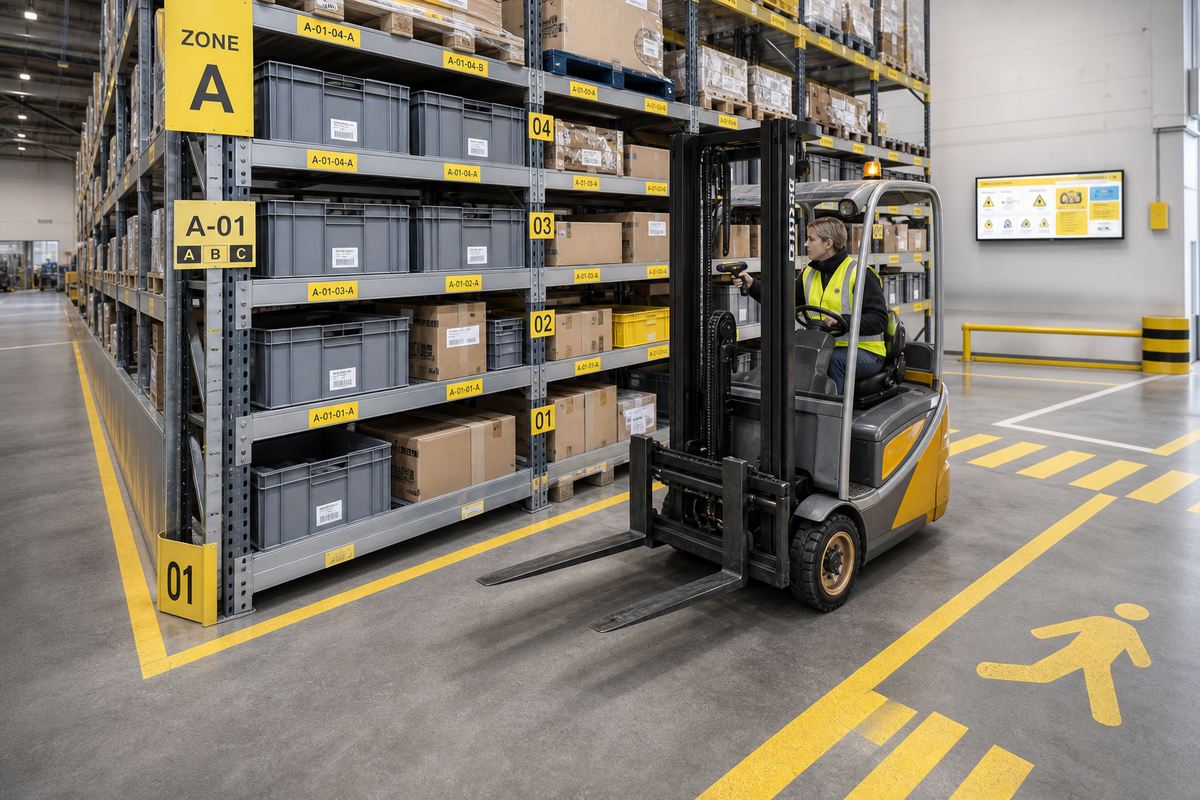
If order pickers in a high-bay warehouse spend three minutes per pick searching for the correct storage location, these losses add up to several hours over the course of a shift. A structured shelf labeling system provides the foundation for reducing search times, misplaced items, and inventory discrepancies in multi-level warehouse structures.
This guide is intended for logistics and warehouse managers at German SMEs and logistics centers. You’ll learn how to set up a labeling system—from addressing to level and bin labeling—which standards are relevant, and which materials have proven effective in practice. ORGATEX supports this implementation as a practical partner with solutions delivered directly at the point of value creation.
What does shelf labeling mean in multi-level warehouse structures?
Shelf labeling refers to the systematic labeling of shelf rows, shelf bays, levels, and individual storage locations. In multi-level warehouse structures—that is, warehouses with shelf racking, pallet racking, or high-bay racking spanning multiple levels—this labeling becomes an operational necessity.
Without unique storage location addresses, there is no link between the physical location on the rack and the data record in the WMS or ERP system. The practical consequence: order pickers head to the wrong aisles, store goods in already occupied locations, or overlook inventory on upper levels.
In warehouses with 500 or more storage locations, this problem becomes particularly acute. Every missing or illegible label results in search time, which adds up over hundreds of picks per day.
Why is systematic warehouse labeling crucial for SMEs and logistics centers in Germany?
In German SMEs and logistics centers, high throughput demands clash with limited personnel resources. When warehouse managers must process more orders with fewer staff, every minute saved at the shelf becomes a measurable advantage.
Clear warehouse labeling reduces search times and picking errors. Companies that have consistently addressed and visually labeled their storage locations report a reduction in travel times of up to 20% and a decrease in misplacements of up to 30%.
Added to this are regulatory requirements: DIN EN 15635 and DGUV Rule 108-007 require operators to equip stationary shelving with load capacity warnings and inspection stickers. A lack of labeling poses a significant liability risk in the event of damage.
This means that professional shelving labeling is not only a matter of efficiency but also a compliance factor that plays a central role in audits and insurance inspections.
What standards and regulations apply to shelving labeling in Germany?
DIN EN 15635: Obligations for Operators of Fixed Shelving Systems
DIN EN 15635 governs the use and maintenance of stationary steel shelving systems. It stipulates that the maximum bay load, bay load, and total load must be permanently and visibly displayed on each shelving bay. Additionally, manufacturer specifications and regular shelving inspections are required.
The standard distinguishes between two levels of inspection: a weekly visual inspection by trained warehouse staff and an annual expert inspection by qualified personnel in accordance with TRBS 1203. Both inspections must be documented, and the current inspection status must be clearly indicated on the rack via inspection stickers.
Annual inspection stickers are color-coded by year so that expired inspection intervals are immediately recognizable. The cost for a set of inspection stickers ranges from three to eight euros per rack section.
DGUV Rule 108-007 and DGUV Information 208-043
DGUV Rule 108-007 defines limit values for stationary shelving and requires that individual load capacity labels specify the actual permissible loads. DGUV Information 208-043 provides practical guidance on shelving safety, including the marking of damaged areas with “Do Not Enter” signs.
Damaged shelving sections must be cordoned off immediately and clearly marked. They may only be released for use again after professional repair and re-inspection. A documented procedure for cordoning off and releasing areas protects operators from liability claims.
How do you set up an addressing system for your warehouse?
Hierarchical Structure of the Storage Location Address
A practical storage location address follows a hierarchical scheme. In the DACH region, a four- to five-level structure has proven effective: zone or storage area, rack row, bin (horizontal position), level (vertical position), and optionally a sub-position for double storage locations.
A typical storage location is then addressed as A-12-05-03: Zone A, rack row 12, bin 05, level 03. Two-digit numbering with gaps (01, 03, 05) creates reserves for future expansions without having to renumber the entire system.
Document the reading direction for all involved. In most warehouses, numbering proceeds from left to right and from bottom to top. This convention must be consistently followed so that new employees can find their way around without lengthy training.
Color Coding as a Visual Orientation Aid
Each warehouse zone is assigned its own color, which is reflected on shelf labels, aisle signs, and floor markings. For forklift operators navigating to the correct storage location from several meters away, color coding is often more crucial than the printed barcode.
ORGATEX offers colored label holders and magnetic signs in all standard 5S colors for this purpose. The color-coded differentiation allows for faster localization of shelves and storage locations, especially in warehouses with many parallel aisles.
Choose colors that can be clearly distinguished from one another even under artificial lighting. Red, yellow, blue, green, and black have proven to be a highly distinguishable combination in practice.
What materials and mounting systems are suitable for shelf labeling?
Magnetic Labeling Solutions
Magnetic label holders are suitable for metal shelving with variable storage location assignments. They can be removed without leaving residue and repositioned when the warehouse layout changes. The scanner-readable transparent profile allows for quick replacement of labels.
ORGATEX magnetic shelf labels offer strong adhesion even on vertical shelf uprights. The standard label profiles, open on three sides, allow for the insertion and replacement of cardboard inserts featuring barcodes, item numbers, or color codes.
Magnetic label holders are available in various standard sizes: from 38 x 75 mm for individual shelf positions to 80 x 200 mm for large-area shelf section labeling.
Self-adhesive insert labels
For fixed storage locations and variable items, self-adhesive solutions are a good choice. Quick-Label insert labels from ORGATEX adhere to shelves, pallets, and containers using foam adhesive. The foam adhesive compensates for uneven surfaces, such as those found on wooden pallets or textured surfaces.
The sturdy, clear profile is open on the sides and at the top, allowing labels to be easily inserted and replaced. Barcodes remain scannable through the transparent profile.
Flexible labels for high-traffic storage locations
In the lower shelf areas, labels are exposed to particularly heavy loads from industrial trucks. The ORGATEX Flex label springs back to its original position after contact with a pallet or forklift. The two-component construction prevents breakage and damage.
This storage label is particularly suitable for marking shelf levels in areas with heavy forklift traffic, where conventional rigid labels are regularly damaged. The plastic grippers securely fasten the label to the shelf crossbar.
Round Tube Label Holders for Tubular Shelving Systems
Tubular shelving systems often cannot be clearly labeled using conventional label holders. ORGATEX’s ergonomically shaped round-tube label holders form a single unit with the shelf profile and do not protrude. Grip points attached to the inner side adhere to both round and profile tubes.
The transparent window, which is open on the side and at the top, allows for quick and easy replacement of the cardboard inserts. For warehouses with mixed shelving types, this solution is a key component of the labeling system.
Select Label Materials Based on Storage Conditions
The choice of material determines the label’s service life. In dry, temperature-controlled shelf warehouses, paper labels with a protective laminate are sufficient. In deep-freeze warehouses, outdoor storage facilities, or production environments with dust, oil, or chemicals, polyester labels are the right choice.
Retroreflective labels are used in high-rack warehouses. They enable laser scanner ranges of up to 12 meters, allowing forklift operators to scan the storage location address directly from the vehicle. According to a technical article on industrie-fachwissen.de, the cost per retroreflective label ranges from 0.50 to 2.00 euros.
How do barcodes and RFID differ in warehouse labeling?
Barcodes: The Standard for Storage Location Labeling
In most warehouses, the barcode is the more economical and reliable choice for storage location labeling. The labels cost just a few cents each, handheld scanners are available in nearly every warehouse, and the technology has been tried and tested for decades.
The DataMatrix code is gaining ground over the classic barcode. It offers a high density of information in a small area and remains readable even if partially damaged. Code 128 remains the standard for general logistics applications.
Barcodes are useful for storage location labeling for another reason: the scanners are already part of the existing IT infrastructure. Handheld scanners, forklift terminals, and mobile data collection devices can be used without additional investment.
RFID: A Complement for Special Use Cases
RFID is used where barcodes reach their limits: for batch scanning of entire pallets at the goods receiving gate, for real-time tracking of load carriers, or when visual access to the label is not possible. The daily costs are significantly higher than those for barcodes.
In practice, many companies rely on a combination: barcodes for storage location identification and order picking, and RFID for inbound and outbound goods tracking. This approach combines cost-effectiveness with speed.
Before investing in RFID, assess your specific use case. If tracking individual picks is the primary focus, barcodes are the more robust choice. For high-volume storage and retrieval operations, RFID can significantly increase processing speed.
Step-by-Step Guide: Setting Up Shelf Labeling in Multi-Level Warehouses
Step 1: Analyze the warehouse structure and define zones
Map out the existing shelving infrastructure: shelving types (shelf, pallet, flow), number of shelving rows, bays per row, and levels per bay. Divide the warehouse into logical zones, such as by product group, turnover frequency, or temperature requirements.
Create a detailed warehouse layout plan showing all rack rows and planned zone assignments. This plan serves as the basis for the addressing system and color coding.
Step 2: Define the Addressing System and Color Scheme
Define the hierarchical addressing scheme using two-digit numbers and leaving room for future expansions. Assign a color to each zone and document the reading direction (left to right, bottom to top) for all stakeholders.
Coordinate the scheme with the IT department to ensure that the addressing structure can be mapped in the WMS or ERP system.
Step 3: Select a mounting system based on shelf type and load
Metal racks with frequently changing contents are equipped with magnetic label holders. Fixed storage locations are provided with self-adhesive insert labels. In the lower rack area subject to forklift loads, flexible labels or anti-stick label holders are used.
Step 4: Design labels and cardboard inserts
Determine what information should appear on the labels: storage location address, barcode (Code 128 or DataMatrix), color code, and, if applicable, item description. ORGATEX manufactures custom cardboard inserts with text, barcodes, and symbols according to your specifications.
Use pre-cut cardboard inserts in standard formats to efficiently design the print templates and quickly apply the labeling.
Step 5: Attach load warning labels and inspection stickers
Attach the load capacity labels required by DIN EN 15635 to each shelving bay, indicating the maximum shelf load, bay load, and total load. Install an inspection sticker system using annual color codes to make the current inspection status recognizable at a glance.
Step 6: Install aisle signs and floor markings
Large, color-coded aisle signs (font height of at least 50 mm) at both ends of the aisle and at intersections enable forklift operators to identify the correct aisle from a distance of 10 to 15 meters. Supplement the signage with color-coordinated floor markings to indicate zones.
Poster frames on the front sides of the racks provide additional visibility and can be mounted in a triangular configuration to be readable from multiple directions.
Step 7: Verify WMS/ERP Integration and Create Master Data
Every physical storage location must be stored as a master data record in the WMS or ERP system. The barcode on the label and the data record in the system must be identical. Before commissioning, verify each storage location with a test scan.
Incorrect or duplicate entries in the master data lead to posting errors, which result in inventory discrepancies and incorrect stock levels.
Step 8: Define Maintenance Intervals and Label Inspection
Schedule regular inspections: As part of the weekly visual inspection in accordance with DIN EN 15635, also check the condition of the labels. Damaged or illegible labels must be replaced immediately to prevent incorrect bookkeeping.
Maintain a stock of replacement labels and box inserts to avoid downtime due to missing materials. Train warehouse staff to report damaged labels on their own so that replacements can be made promptly.
What common mistakes should you avoid when labeling shelves?
Numbering that is too tight is one of the most common mistakes. If you number shelf rows consecutively from 1 to 20 without any gaps, you won’t have room for future expansions and will have to renumber the entire addressing system during renovations.
Lack of maintenance of the labeling system leads to labels becoming illegible due to impacts, moisture, or UV exposure. The result: pickers scan the wrong location or store goods in the wrong place.
Inconsistent systems arise when different warehouse areas use different addressing schemes or color schemes. New employees then require significantly longer training periods, and the error rate increases.
Another common mistake is neglecting load-capacity labeling. Missing or outdated load-capacity labels on shelves violate DIN EN 15635 and can lead to significant liability consequences in the event of damage.
A lack of alignment between physical labeling and WMS master data is also a common problem. When a storage location exists physically but is not created in the system, “ghost” storage locations are created. Conversely, system entries without a physical counterpart lead to misallocations during automatic putaway.
How does ORGATEX support you with professional shelf labeling?
ORGATEX brings over 50 years of practical experience in industrial labeling. The product range for shelf labeling includes magnetic label holders, self-adhesive insert labels, flexible labels, round-tube label holders, colored and transparent options, as well as custom-printed cardboard inserts.
All solutions are designed so that labels can be quickly inserted, replaced, and scanned—practical, straightforward, and immediately productive. The materials are engineered to withstand the stresses of daily warehouse operations, including the lower storage bay area, where industrial trucks cause additional wear and tear.
You can request samples and test the products in your own warehouse before deciding on a system. For customized requirements, please contact us at +49 2173 10640 for consultation.
Conclusion: Shelf Labeling as the Foundation for Safe and Efficient Warehouse Operations in Germany
Professional shelf labeling is not a one-time project, but rather a system component that reduces search times, minimizes picking errors, and meets regulatory requirements under DIN EN 15635. The investment in a well-designed labeling system pays for itself even with just a few hundred storage bins.
As your practical partner, ORGATEX provides you with the tools to systematically set up your warehouse labeling and keep it up to date over the long term. From consulting to custom label production to selecting the right mounting system, you get everything from a single source.
Start by analyzing your warehouse structure and setting up a hierarchical addressing system. Choose materials and mounting solutions that are suitable for your shelf types and load capacities. And check regularly to ensure that all labels are legible and all inspection stickers are up to date.
Call +49 2173 10640 now to schedule a consultation or request samples directly at orgatex.com.
FAQs: Professional Shelf Labeling in Germany
What is a storage location address, and how is it structured?
A storage location address is a hierarchical code that uniquely identifies a physical storage location. It typically consists of a zone, rack row, bin, and level. ORGATEX label holders are designed so that this address structure can be displayed on the label using both a barcode and plain text.
What standards apply to shelving labeling in Germany?
DIN EN 15635 and DGUV Rule 108-007 require load capacity warnings, manufacturer information, and inspection stickers on stationary racks. The weekly visual inspection and the annual expert inspection must be documented. ORGATEX labeling systems help you comply with these regulations.
When are magnetic label holders a better choice than self-adhesive ones?
Magnetic label holders are the better choice for metal racks with frequently changing storage locations. They can be removed without leaving residue and repositioned. Self-adhesive insert labels, on the other hand, are suitable for fixed storage locations with varying items.
How do I protect shelf labels in the lower storage areas from forklift damage?
ORGATEX Flex labels spring back to their original position after contact with pallets or forklifts. The two-component construction prevents breakage and significantly extends the label’s service life, even under heavy forklift traffic.
Can I have shelf labels custom printed with barcodes and color codes?
Yes. ORGATEX manufactures custom carton inserts and labels with text, barcodes (Code 128, DataMatrix), color codes, and symbols according to your specifications. The inserts fit into all standard ORGATEX label holders and are scannable.
Which label materials are suitable for frozen food warehouses or outdoor storage facilities?
Polyester labels are the right choice for frozen storage and outdoor warehouses. They are resistant to low temperatures, moisture, oils, and UV radiation. In high-bay warehouses with forklift operations, retroreflective labels are also used for long-distance scanning.
