
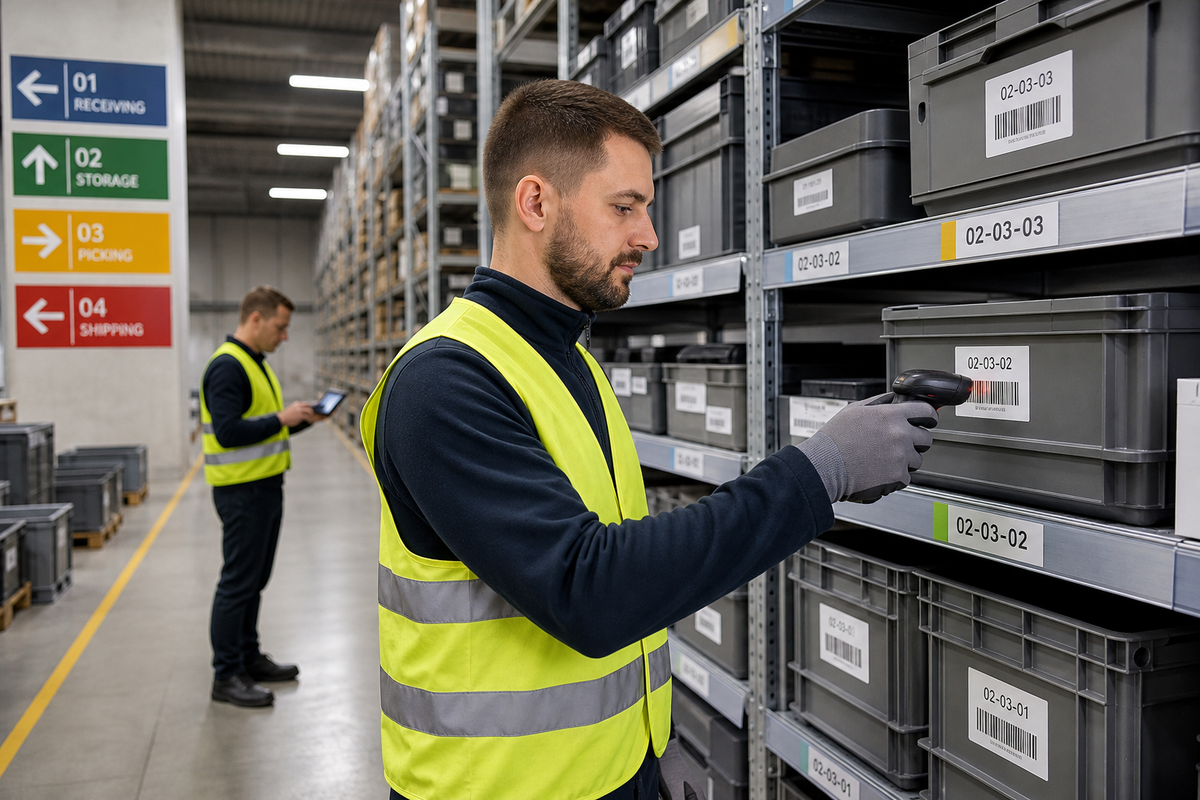
When containers in the warehouse lack a unique identifier, the search begins: warehouse staff check delivery slips, compare labels by hand, and lose valuable minutes per shift. In manufacturing and logistics SMEs, this problem affects not only individual storage locations but the entire material flow—from goods receipt to staging at the production line. Systematic container labeling using barcode systems transforms this manual search process into a structured, scanner-based workflow.
This guide shows you, step by step, how to set up a barcode-based labeling system for your containers. You’ll learn which barcode types are suitable for KLTs, Euro boxes, and mesh boxes, how to select the right label media, and what mistakes to avoid. ORGATEX supports this process as a practical partner with solutions directly at the point of value creation.
Key Takeaways: Container Labeling with Barcodes
- Barcode-based container labeling measurably reduces search times and misplacements in warehousing and manufacturing.
- A hierarchical location code (hall, aisle, shelf, compartment) forms the basis for every scanner-readable labeling system.
- The choice between magnetic, self-adhesive, and insert-type label holders depends on the container material and how frequently labels are replaced.
- ORGATEX offers scanner-readable clear pockets, KANBAN sleeves, and label holders that protect barcode labels and enable quick replacement.
- A pilot area with 50 to 100 containers provides reliable data before the entire warehouse is converted.
What does container labeling with barcode systems mean?
Container labeling with barcode systems refers to the systematic assignment and physical application of machine-readable codes to KLTs, Euroboxes, mesh boxes, and other load carriers. Each container receives a unique identification code that is scanned and linked to a data record in the WMS or ERP system.
Without this link, there is no connection between the physical container on the shelf and the digital inventory data. In practice, this means that staff must search for containers manually, cross-check paper documents, and enter information into the system by hand. Each of these steps creates a media break that increases the risk of errors and wastes time.
With a barcode on the container or its label holder, a single scan is all it takes to capture the item number, storage location, and quantity. This process takes less than two seconds and virtually eliminates manual data entry errors.
Why do SMEs in manufacturing and logistics benefit in particular?
In SMEs in manufacturing and logistics, limited personnel resources are pitted against rising throughput demands. Warehouse staff often take on multiple roles simultaneously: putaway, order picking, replenishment, and inventory. Every minute lost searching for incorrectly labeled containers is a minute missing elsewhere.
A barcode system alleviates these bottlenecks by reducing the identification process to a single scan. This is particularly effective in warehouses with 200 to 2,000 containers, where manual lists reach their limits, but a fully automated RFID system exceeds an SME’s investment budget.
Furthermore, in many medium-sized companies, shift teams have varying levels of experience. A standardized barcode system makes container identification independent of individual knowledge and ensures consistent process quality across all shifts.
At the same time, barcode-based labeling creates a data foundation on which future optimizations can be built: Movement data reveals which containers are frequently handled, enabling more targeted shelf labeling and storage location assignment.
Which barcode types are suitable for container labeling?
Code 128 as the Industry Standard
Code 128 is the most widely used linear barcode type in warehouse and manufacturing logistics. It encodes alphanumeric characters in a space-saving manner, supports an integrated check digit, and can be read by any standard scanner. For a container code such as “L-03-R02-F04,” a Code 128 barcode 30 mm wide with a bar width of 0.25 mm is sufficient.
Code 128’s strength lies in its robustness: even with light soiling, an oblique scanning angle, or abrasion, the code remains readable in most cases. It is the most reliable choice for pure storage location and container labels.
QR Codes and DataMatrix for Additional Data
If you want to store additional information alongside the container ID—such as a URL to a digital product file or lot numbers—2D codes are ideal. QR codes and DataMatrix encode significantly more characters in a smaller space.
However, 2D codes require more powerful scanners or cameras, and the minimum print size for reliable reading is approximately 15 × 15 mm. In environments with heavy soiling or high abrasion, Code 128 is the more robust alternative.
How do you set up a container labeling system step by step?
Step 1: Define the location system
Before the first label is printed, the location system must be documented in writing. A hierarchical structure that reads from the outside in has proven effective: building, aisle, shelf, level, bin. A typical code would then look like this: “A-03-02-04” (Hall A, Aisle 3, Shelf 2, Bin 4).
This code is assigned to both the storage location and the container. This allows the WMS to track at any time which container is located where. The system should be scalable: if a new aisle is added, the existing coding system should not need to be reconfigured.
Step 2: Record and Classify Container Types
List all container types currently in use: KLT (small load carriers), Euro boxes, mesh boxes, open-fronted storage bins, and custom shapes. For each type, note the material (plastic, metal, wood), whether inserts or card slots are already present, and the typical operating environment (dry, oily, refrigerated area, ESD area).
This classification determines which label holder and fastening system should be used. A metal container inside a mesh box requires a different solution than a KLT with a pre-punched card slot.
Step 3: Select the label carrier and fastening system
Choosing the right label holder is crucial to the practicality of the entire system. ORGATEX offers three main categories here:
- Magnetic clear pockets and label holders: They adhere to all ferrous surfaces and can be installed without tools. They are the top choice for mesh boxes and metal containers with frequently changing contents.
- Self-adhesive clear pockets: Foam adhesive strips ensure a secure hold on plastic, wood, glass, and smooth metal surfaces. They are suitable for permanent assignments where the container retains its label holder.
- Insert systems and KANBAN sleeves: For KLT containers with existing card slots or inserts, scanner-readable KANBAN sleeves fit directly into the designated holder. The barcode label is stored securely and can be replaced at any time.
Step 4: Print and attach barcode labels
Thermal transfer printing has become the standard method for printing barcode labels. The symbols are abrasion-resistant, UV-stable, and remain scannable for years. Direct thermal prints fade within a few months in warm storage environments and are not suitable for permanent labeling.
The labels are inserted into the selected label holder or placed behind the transparent profile. Make sure the barcode is not compromised by creases, shadows, or reflections from the transparent material. ORGATEX transparent profiles are designed to ensure error-free scanning even through the protective sleeve.
Step 5: Set Up and Test a Pilot Area
First, fully label a designated area containing 50 to 100 containers. Test the processes of putaway, picking, replenishment, and inventory during daily operations. Measure scan rates, reading distances, and the duration of transaction processes.
During the pilot phase, also document feedback from warehouse staff: Are the barcodes easily readable from the typical scanning distance? Does the label carrier withstand normal mechanical stress? Are the codes correctly stored in the WMS?
Only once the pilot phase has yielded reliable data and the system has been validated will it be rolled out to the entire warehouse. This approach reduces implementation risk and fosters acceptance within the team, as those involved directly experience the improvements in day-to-day operations.
What materials and environmental conditions influence label selection?
Dry Indoor Warehouses
In dry, temperature-stable indoor warehouses, PET or PE film labels in a label carrier are sufficient. They are waterproof, scratch-resistant, and last for years. The label carrier itself also protects the barcode label from mechanical abrasion caused by forklift tines or the edges of packaging.
Refrigerated Areas and Outdoor Warehouses
For temperatures below 0 °C, polyester labels with special adhesives that do not become brittle in cold conditions are recommended. ORGATEX clear pouches in ESD-compliant or cold storage variants protect the label from condensation and mechanical stress.
Oily or dusty production areas
In production environments with oil, dust, or mild chemicals, the protective function of the label carrier is crucial. Sealed clear pouches keep contaminants away from the barcode while still allowing for reliable scanning through the transparent material.
How do you integrate container labeling into your WMS or ERP?
Physical labeling on the container only realizes its full benefit when integrated with your WMS or ERP system. The barcode on the container must correspond to a data record in the system that contains the item number, quantity, storage location, and, if applicable, the lot number.
Integration occurs during the scanning process: A handheld scanner or mobile terminal reads the container barcode and the storage location barcode one after the other. The system automatically records the assignment. This process replaces the manual entry of inventory movements and eliminates the typical data silos between the shop floor and the IT system.
For SMEs that do not yet use a full-fledged WMS, a simple spreadsheet solution can serve as a temporary workaround. The key is to link the coding on the container to digital recording from the very beginning.
What distinguishes physical label holders from directly applied barcode labels?
Directly applied barcode labels adhere firmly to the container wall. They are slim, take up no additional space, and are suitable for containers with a fixed item assignment that rarely changes.
Physical label holders, such as those offered by ORGATEX in the form of magnetic clear pockets, self-adhesive clear profiles, or insert rails, offer a key advantage: The barcode label can be replaced at any time without removing the holder. This is particularly relevant in environments with frequently changing product assignments, seasonal assortment changes, or Kanban-controlled material cycles.
In addition, the label holder protects the label from abrasion, moisture, and dirt. In practice, this protection extends the readability of the barcode many times over compared to an unprotected sticker.
Another advantage: If a label holder is damaged, it can be replaced individually without having to relabel the entire container. This saves material and time during ongoing operations.
What role does shelf labeling play as a supplement to container labeling?
Container labeling alone does not fully solve the problem of locatability. If the container has a barcode but the shelf location is not clearly marked, the question remains: Where exactly is this container located?
Only the combination of the container barcode and the shelf location barcode closes the loop. Each storage location is assigned its own address (e.g., “R03-E02-F05”), which is affixed to the shelf compartment as a label. When putting goods away, the operator first scans the storage location, then the container. The system records the assignment in real time.
ORGATEX offers a well-designed range of shelving labels, including magnetic storage labels, Quick-Label insert labels, and flexible labels that can withstand impacts from forklifts.
What common mistakes should you avoid when implementing this system?
Inconsistent numbering system
If different departments use their own codes or the system cannot be expanded, duplicates and gaps will occur. Define the coding centrally and document the rules in a binding work instruction before the first label is applied.
Incorrect Label Placement
The barcode label should be placed in a location that is easily accessible to the scanner while remaining protected from mechanical stress. On KLT containers, the front side is ideal. On mesh boxes, the clear pocket should be positioned so that it is not obscured when stacked.
Inappropriate label material
Direct-thermal labels fade within a few months in warm environments. For permanent container labeling, thermal transfer printing on PET or polyester film is the most durable option. Combined with a protective label backing, the barcode remains scannable for years.
Lack of Training for Those Involved
A new labeling system only works if everyone involved applies it consistently. Train warehouse staff, forklift operators, and shift supervisors before the system goes live. Demonstrate the specific process: scan the container, scan the storage location, and verify the transaction. Intuitive solutions like ORGATEX’s visual labeling systems make training easier because they use colors, clear formats, and consistent placement locations.
How does container labeling improve your inventory processes?
The annual cutoff-date inventory is one of the most time-consuming processes in the warehouse. In small and medium-sized businesses (SMEs), it often ties up staff for several days, leaving them unavailable for day-to-day operations. With complete barcode labeling of all containers and storage locations, this effort can be significantly reduced.
Instead of using paper lists and manual reconciliation, your staff scan the storage location code and the container barcode one after the other. The system automatically logs the count. Illegible handwriting, duplicate entries, and transcription errors are eliminated.
Those who wish to switch to continuous inventory can do so in stages: First, fully label the fast-moving item storage locations, practice the process, and then gradually expand it to the entire product range. Barcode labeling provides the technical foundation for this.
How does container labeling support Kanban-controlled material cycles?
In Kanban-controlled manufacturing environments, containers follow a defined cycle between the point of use and the replenishment source. The barcode on the container not only identifies the contents but also signals the need for replenishment: When an empty container is scanned, the system automatically triggers a replenishment request.
ORGATEX KANBAN sleeves protect the scannable Kanban card and enable quick replacement when switching items. When combined with the ORGATEX OX Kanban sensor, which monitors fill levels contactlessly and automatically triggers replenishment processes, a fully digital replenishment cycle is created directly at the point of use.
Which norms and standards are relevant for warehouse labeling?
Two sets of regulations form the regulatory framework for labeling in German warehouses:
- DIN EN 15635: This standard prescribes the inspection and safe operation of stationary shelving systems. Among other things, it requires load warning labels (maximum shelf load, bay load, and total load), manufacturer specifications, and annual inspection stickers.
- DGUV Rule 108-007: This rule defines requirements for warehouse facilities and equipment, including labeling requirements for traffic routes and hazard zones.
Container labeling itself is not required by law, but it is a component of good operational practice that is regularly required by audit procedures under ISO 9001 or industry-specific standards (e.g., VDA 5007 for container management in the automotive industry). According to the VDA Guideline 5007, unique packaging identification is a fundamental prerequisite for effective container management.
How do you calculate the return on investment for your container labeling?
The investment in a barcode-based labeling system consists of three components: label media and accessories, barcode printers and scanners, and the one-time project time required for coding, application, and training.
The benefits can be measured in terms of concrete process improvements. In practical operation, companies report a 20% reduction in search times, a 30% decrease in misplacements, and an acceleration of inventory processes by up to 50%.
For an SME with 1,000 containers and three warehouse staff members, the break-even point is typically reached within a few months when the labor time saved is offset against the project costs.
In addition, barcode-based labeling also reduces indirect costs: fewer incorrect deliveries to the production line, less rework due to incorrectly prepared materials, and faster response times to last-minute order changes.
Conclusion: Container labeling with barcodes as the foundation for transparent warehouse processes
Systematic container labeling using barcode systems lays the foundation for transparent, traceable, and faster warehouse processes in SMEs. It links the physical container to the digital data record, reduces search times and misplacements, and provides the data foundation for future optimizations in material flow.
ORGATEX supports this setup with scanner-readable clear pockets, label holders, KANBAN sleeves, and shelf labeling solutions that adapt to different container types, mounting requirements, and environmental conditions. This creates structure where it’s needed in day-to-day operations: right at the point of value creation.
Would you like to set up your labeling system in a practical way? Call us at +49 2173 10640 to schedule a personalized consultation.
FAQ: Container Labeling with Barcode Systems
What is container labeling with barcodes?
Container labeling with barcodes means that each load carrier is assigned a machine-readable code that is captured by a scanner. This code links the physical container to a data record in your WMS or ERP system.
Which barcode types are suitable for KLTs and Euro boxes?
Code 128 is the industry standard for container and storage location labels. It is space-efficient, resistant to dirt, and readable by any standard scanner. QR codes are ideal when additional data, such as batch numbers, needs to be stored.
How do I attach barcode labels to different types of containers?
ORGATEX offers magnetic clear pockets for metal containers, self-adhesive clear pockets for plastic and wooden containers, and insert systems for KLTs with existing card slots. This ensures you have the right attachment for every container type.
Do I also need to label the storage location with a barcode?
For a complete inventory overview, you should label both the container and the storage location with a barcode. ORGATEX shelf labeling solutions, such as magnetic storage labels and Quick-Label insert labels, complement container labeling and close the loop in the WMS.
How long does it take to implement a barcode system in an SME warehouse?
With a structured pilot phase, you can expect it to take two to three workdays for the first 50 to 100 containers. Expanding the system to the entire warehouse depends on the number of containers. ORGATEX will support you as needed, from consultation and product selection to on-site implementation.
What advantages does container labeling offer for inventory management?
Barcode-based inventory replaces paper lists with scan logs. This eliminates transcription errors and significantly speeds up the counting process. ORGATEX label holders ensure that the barcode on the container can still be read flawlessly even after many years.
