
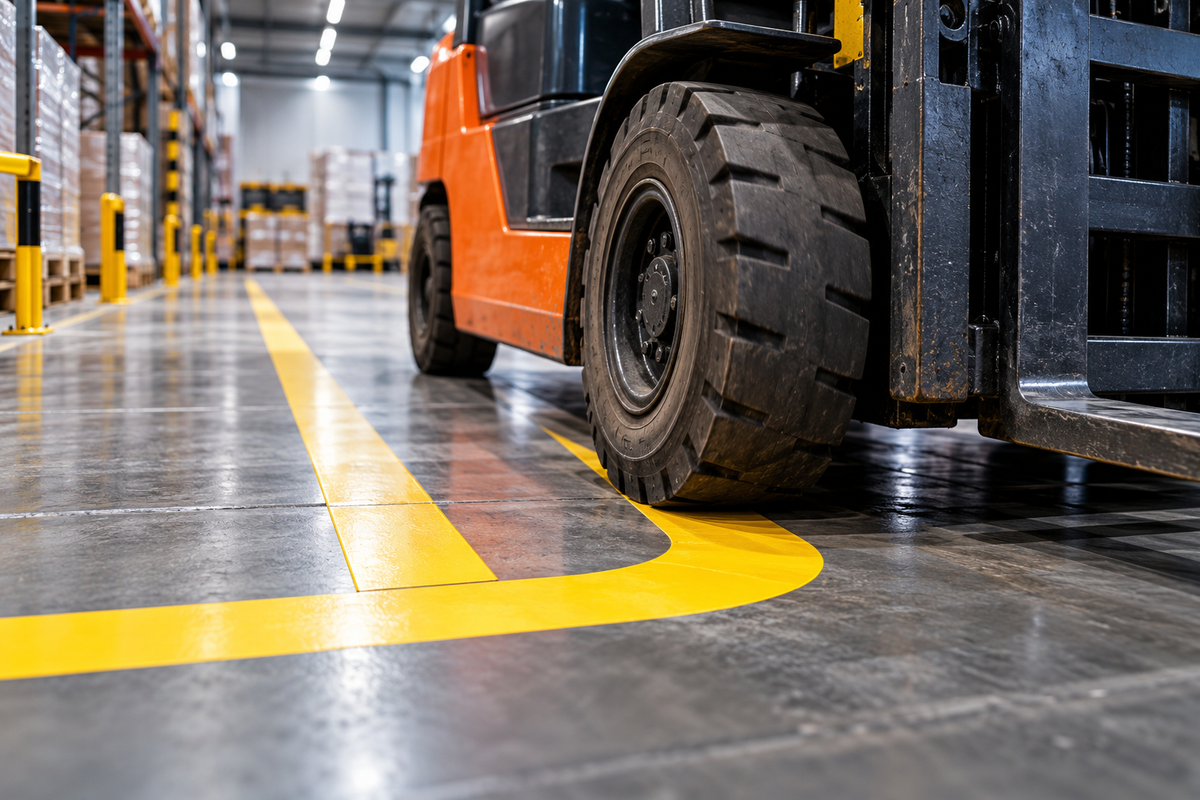
Why do floor markings in logistics and production so often fail after just a few months? The reason is rarely a lack of maintenance. It’s due to choosing the wrong material for the actual load. Forklifts turning on the spot, pallet jacks in continuous operation, and heavy loads generate compressive and torsional forces that systematically destroy conventional markings. This guide shows you how to select heavy-duty floor markings for forklift traffic and 5S zones that will last even under extreme conditions.
You’ll learn what types of stresses occur in your facility, which materials can withstand these forces, and how a well-thought-out color scheme based on ASR A1.3 improves both workplace safety and process reliability. ORGATEX supports you with floor markings specifically developed for the toughest conditions in logistics and production.
Key Takeaways: Durable Floor Markings for Logistics and Production
- The choice of material determines the service life of a floor marking—not just the application or maintenance.
- Rotating forklift wheels generate torsional forces that prematurely destroy conventional adhesive tapes and paint coatings.
- A color scheme compliant with ASR A1.3 improves workplace safety and facilitates navigation within the facility.
- With its Vector™ floor marking system, ORGATEX offers a solution specifically designed to withstand the stress of rotating forklift wheels.
- The systematic planning of 5S zones with durable markings reduces maintenance costs and increases process reliability.
Why Conventional Floor Markings Fail Under Forklift Traffic
In production halls and logistics centers, mechanical forces act on the floor that far exceed what marking manufacturers simulate in their standard tests. The problem doesn’t start when a forklift drives over the markings. It starts when it turns.
When a forklift turns in place, extreme torsional stresses are generated. The wheel not only exerts vertical pressure on the marking but also twists the material in multiple directions simultaneously. The result: cracks, deformations, peeling at the edges, and ultimately the complete destruction of the marking.
Three factors accelerate this wear:
- Base material that is too soft: It yields under load and becomes permanently deformed, causing the marking to lose its contour.
- High friction between the wheel and the surface: Transfers the torsional forces directly into the marking instead of dissipating them.
- Inappropriate adhesive systems: Gradually detach from the substrate under rotational stress, starting at the edges.
The result is a cycle of re-marking, production interruptions, and rising maintenance costs. Many companies accept this situation as inevitable. It is not.
What types of loads occur in logistics and production areas?
Before selecting a floor marking, you should systematically assess the actual loads in your facility. Not every area is subjected to the same stresses, and the right marking depends directly on the load profile.
Vertical pressure from industrial trucks
Counterbalanced forklifts exert several metric tons of pressure on their wheels, depending on the model and payload. With small, hard tires, this pressure is concentrated on a small contact area. The marking must absorb this surface pressure without undergoing plastic deformation.
Torsional and Shear Forces During Steering Maneuvers
The most critical load condition occurs when turning in place, particularly with forklifts featuring rear-wheel steering in narrow aisles. This generates shear forces that attempt to peel the marking material away from the substrate. Only materials with high shear stiffness and a corresponding adhesive system can withstand this stress over the long term.
Abrasion from Continuous Operation and Cleaning
In shift operations with high traffic volume, abrasion accumulates over weeks and months. Added to this is the mechanical stress caused by cleaning machines, wet cleaning, or chemical cleaning agents. A durable floor marking must remain clearly visible, even after thousands of vehicle passes and cleaning cycles.
Especially in the food and pharmaceutical industries, where strict hygiene regulations apply, floors are cleaned mechanically every day. The marking must permanently withstand this combined stress from mechanical abrasion and chemical exposure.
Temperature-Related Stresses
Refrigerated and frozen storage facilities present additional challenges. Adhesives lose their tack at low temperatures, and brittle materials break under mechanical stress. These areas require specially developed markings that adhere reliably even at temperatures as low as minus 20 degrees Celsius.
Which marking systems are suitable for high-traffic areas?
Three basic systems are available for floor marking in industry and logistics: self-adhesive marking tapes, liquid paint systems, and prefabricated molded parts. Each system has specific strengths and limitations.
Self-adhesive marking tapes made of high-performance plastic
Self-adhesive tapes are made of torsion-resistant plastic and are applied directly from the roll dispenser to the prepared floor. They can be walked on immediately and can withstand full loads after a short curing time. Installation requires no drying time and causes no odor nuisance, which allows for use during ongoing production.
The combination of backing material and adhesive is crucial for service life. High-quality systems use specially developed adhesives that adhere permanently even to smooth epoxy resin floors and can be removed without leaving residue if necessary.
Liquid Marking Systems and Two-Component Coatings
Liquid-applied markings, particularly two-component polyurethane-based systems, offer high mechanical resistance. They bond integrally with the substrate and can withstand even heavy forklift traffic.
The disadvantages: Application requires a curing time of at least 24 hours, during which the marked area must not be driven on. In addition, subsequent layout changes are time-consuming, as the markings can only be removed with considerable effort.
Pre-made symbols and molded parts for 5S zones
Pre-made symbols and cut-to-size pieces are ideal for marking parking spaces, corners, and restricted areas as part of 5S projects. They specifically mark individual positions without the need to draw entire lines. When combined with tape, they can be used to create complete 5S layouts.
Selection Criteria for Durable Floor Markings in Detail
Selecting the right floor marking is not a decision based solely on a catalog. It requires a systematic assessment of operational requirements. The following criteria will help you find the right solution for your spaces.
Load Profile and Traffic Volume
First, determine which industrial trucks operate in the area and how frequently. In areas with heavy forklift traffic and frequent turning movements, you’ll need markings with high torsional strength. In less heavily used zones, a standard product may suffice.
Substrate and Surface Condition
The adhesion of a self-adhesive marking depends directly on the substrate. Smooth industrial floors made of epoxy resin or polished concrete offer the best conditions. Rough, porous, or oil-contaminated floors require thorough pretreatment or a specially adapted adhesive system.
Flexibility for Layout Changes
In facilities with frequently changing production layouts, the ability to remove markings without leaving residue is a critical factor. Self-adhesive systems with a suitable adhesive can be removed and repositioned. ORGATEX LongLife floor markings are designed to be removed without leaving residue and without damaging the industrial floor.
Temperature Range and Environmental Conditions
Special requirements apply to deep-freeze areas, cleanrooms, or ESD zones. With LongLife Cold Performance, ORGATEX offers a marking system specifically developed for industrial environments with extremely low temperatures down to minus 20 degrees Celsius.
Visibility and Color Fastness
A floor marking only serves its purpose if it remains clearly visible even after months of intensive use. High-quality markings use solid-colored materials in which the color is not merely applied to the surface but permeates the entire material.
How ORGATEX’s Vector™ Solves the Problem of Rotating Forklift Wheels
With Vector™, ORGATEX has developed a floor marking specifically designed to withstand the most extreme type of stress in industrial environments: rotating forklift wheels. Instead of making compromises, Vector™ relies on a material-optimized design that addresses every single wear factor.
The slim design reduces torsional forces within the material and minimizes stress during rotational movements. A friction-optimized surface dissipates shear forces rather than transferring them to the marking. The high-strength backing film, with its defined elasticity, retains its dimensional stability even under repeated stress.
The high-performance adhesive system securely anchors the marking to the substrate even under the most intensive use and prevents edge peeling. The smooth texture facilitates cleaning and maintains visibility throughout the entire service life.
For you, this means: significantly longer service life, substantially reduced maintenance intervals, and thus lower operating costs right where value is created.
The Right Color Concept According to ASR A1.3 for Your Operational Areas
A well-thought-out color scheme is more than just a visual measure. It provides orientation, enhances workplace safety, and supports compliance with legal regulations. The Technical Rule for Workplaces (ASR A1.3 ), together with DIN EN ISO 7010, defines the basis for color-coding traffic routes and hazard zones.
Color Assignment for Functional Areas
The following color assignments have become the standard in logistics and production:
| Color | Function | Recommended width |
|---|---|---|
| Yellow | Main and secondary routes for people and vehicles | 75 to 100 mm |
| Green | Finished goods and goods ready for delivery | 50 to 75 mm |
| Blue | Raw materials, incoming shipments, and materials in process | 50 to 75 mm |
| Red | Scrap, missing parts, and restricted storage areas | 50 to 75 mm |
| Black-Yellow | Hazardous areas and obstacles | 50 to 75 mm |
| Red-White | Fire extinguishing equipment and no-smoking zones | 50 to 75 mm |
The color-coded system provides a quick overview of material availability and the occupancy of storage spaces. Ensure that no more than two marking strips are directly adjacent to one another. Otherwise, visibility decreases significantly.
Safety Markings for Traffic Routes
Forklift traffic lanes must be clearly separated from pedestrian walkways. ASR A1.3 recommends highly visible, high-contrast stripes, preferably in white or yellow, with a minimum width of five centimeters. At intersections where forklift and pedestrian paths cross, additional black-and-yellow warning markings are recommended.
In addition to floor markings, you can use the OX-Spot in safety-critical intersection areas. This LED floor projection system from ORGATEX dynamically projects warning signs onto the roadway, thereby increasing visibility without mechanical wear.
Implementing 5S Zones with Durable Floor Markings
The 5S method relies on clear structures in the workplace: Sort, Set in Order, Shine, Standardize, and Sustain. Floor markings are one of the most effective tools for making these structures physically visible and permanently established.
Defining storage locations and staging areas
Every material storage location, every staging area, and every container location is assigned a unique marking. When positioning the markings, maintain a minimum distance of 30 to 50 millimeters between the marking and the stored material. This distance significantly reduces wear caused by industrial trucks during loading and unloading.
Increase the Level of Detail with Floor Signs and Clear View Windows
If color markings alone are not sufficient, floor signs with transparent covers can be used to supplement the labeling. Custom labels, barcodes, QR codes, or item numbers can be printed in DIN format and inserted into the clear labels. The special surface texture prevents glare and ensures scanner readability.
Ensuring the Durability of 5S Markings
The most common reason for the failure of 5S projects: The markings wear out, and with them, the standards disappear. Durable markings that remain intact even after months of intensive use are the physical foundation for sustainable Lean standards. ORGATEX supports you with markings that are practical, straightforward, and immediately ready for productive use.
Step by Step: How to Plan and Install Floor Markings Correctly
A durable floor marking will only achieve its full service life if it is properly planned and installed. The following steps will guide you systematically through the process.
Step 1: Area Analysis and Layout Planning
First, define which areas are to be marked: traffic lanes, walkways, parking spaces, hazard zones, and 5S areas. Assess traffic flows and identify bottlenecks and intersections. With the Gemba Walk, ORGATEX offers an on-site analysis to jointly identify weak points and opportunities for optimization.
Step 2: Prepare the Substrate
The surface must be absolutely clean, dry, and free of dust and grease. Oil residues, silicone residues, or loose coatings significantly impair adhesion. Use suitable cleaning agents and allow the floor to dry completely before beginning installation.
Step 3: Lay the Marking
Apply the self-adhesive tape in sections, taking care to avoid air pockets. Press the tape firmly with a pressure roller to activate its full adhesive strength. After approximately 24 hours of curing time, the marking is fully load-bearing and can be driven over by industrial trucks.
Step 4: Quality Control and Documentation
After installation, check the adhesion at critical points, especially along edges and transitions. Document the color scheme and installation locations to ensure a consistent system is maintained in the event of future layout changes.
Avoiding Common Mistakes in Selection and Installation
In practice, the following errors most frequently lead to premature marking failure and unnecessary costs.
Decisions Based Solely on Purchase Price
The purchase price of a floor marking says little about the actual costs. What matters most are the lifecycle costs: How long will the marking last under real-world conditions? How often will it need to be reapplied? What downtime results from road closures? A product that seems inexpensive but must be replaced after just a few months is the more expensive choice in the long run.
Underestimating Actual Stress
Many companies choose their markings based on the catalog term “forklift-resistant” without distinguishing between the actual types of stress. Driving over and turning are two fundamentally different types of stress. A marking that withstands linear traffic may fail under rotational stress.
Inadequate floor preparation
Residues of oil, grease, or old adhesives prevent permanent adhesion. In practice, surface preparation is most often neglected, even though it determines the service life of the entire marking.
Lack of a Maintenance Strategy
Even the most durable markings benefit from regular inspection. Schedule inspection intervals to detect and repair damage early, before it spreads. In high-traffic areas, a visual inspection every six months is recommended.
How to Use ORGATEX’s Installation Service for Your Floors
Not every company has the internal resources to professionally install large-scale floor markings. With its professional installation service, ORGATEX offers a solution that combines planning, consultation, and professional installation directly on-site.
The service includes an analysis of your floors, joint development of the color scheme, and professional installation by trained personnel. This saves you time and effort, reduces installation errors, and ensures that the markings achieve their full service life.
Especially for new facilities or extensive redesigns of production and warehouse areas, the professional installation service is an investment that pays off over the entire service life. Implementation takes place directly on-site, coordinated with your ongoing operations.
Summary: How to Choose the Right Floor Marking for Your Needs
Choosing the right floor marking starts with analyzing the actual load conditions in your facility. Determine which industrial trucks operate in which areas, how frequently turning maneuvers occur, and what environmental conditions prevail.
Choose the marking system that matches this load profile. For high-traffic areas with forklift traffic, self-adhesive high-performance tapes offer the best combination of durability, flexibility, and cost-effectiveness. For the most extreme torsional loads caused by rotating forklift wheels, ORGATEX’s Vector™ floor marking provides a superior solution in terms of material technology.
Establish a uniform color scheme in accordance with ASR A1.3, carefully prepare the substrate, and schedule regular inspections. With these fundamentals in place, you’ll create durable floor markings that enhance workplace safety, reduce maintenance costs, and make your lean standards permanently visible.
Would you like to have your floors professionally analyzed? Schedule a Gemba Walk with ORGATEX: +49 2173 10640.
Frequently Asked Questions About Durable Floor Markings
What does “forklift-resistant” mean for floor markings?
“Forklift-resistant” means that a floor marking can withstand being driven over by industrial trucks without peeling off or wearing away. However, it’s important to distinguish: Not every forklift-resistant marking can also withstand rotational movements. With Vector™, ORGATEX offers a marking specifically developed for this most extreme type of stress.
What colors does ASR A1.3 specify for floor markings?
ASR A1.3 does not define mandatory colors for all operational areas, but requires highly visible, high-contrast markings. Yellow or white are recommended for traffic routes, while hazard areas must be marked in black-and-yellow or red-and-white. For organizational areas such as parking spaces and material zones, a company-specific color scheme using yellow, green, blue, and red has become the standard.
How long do heavy-duty floor markings last under forklift traffic?
The service life depends on the type of marking, the intensity of the load, and the floor preparation. High-quality self-adhesive markings last several years under normal conditions. In cases of extreme torsional stress caused by rotating forklift wheels, the ORGATEX Vector™ marking offers significantly longer service life than conventional systems.
Can floor markings be applied during ongoing production?
ORGATEX self-adhesive floor markings can be applied directly during ongoing operations without causing any unpleasant odors or requiring long drying times. The marking is immediately walkable and can withstand full loads after about 24 hours. Liquid two-component systems, on the other hand, require the marked area to be off-limits for a certain period.
How do floor markings support the implementation of the 5S method?
Floor markings make the core principles of 5S physically visible: designated storage locations, separate functional areas, and uniform standards. ORGATEX offers a system consisting of tape, symbols, pre-cut pieces, and clear windows that can be combined in a modular fashion to create complete 5S layouts. Durable markings ensure these standards are maintained long-term, rather than fading away after just a few months.
How much does professional floor marking for a production hall cost?
The cost depends on the floor area, the chosen marking system, and the extent of floor preparation. Self-adhesive marking tapes generally offer the most cost-effective balance between initial cost and service life. Contact ORGATEX at +49 2173 10640 for personalized advice and a recommendation tailored to your space.
