
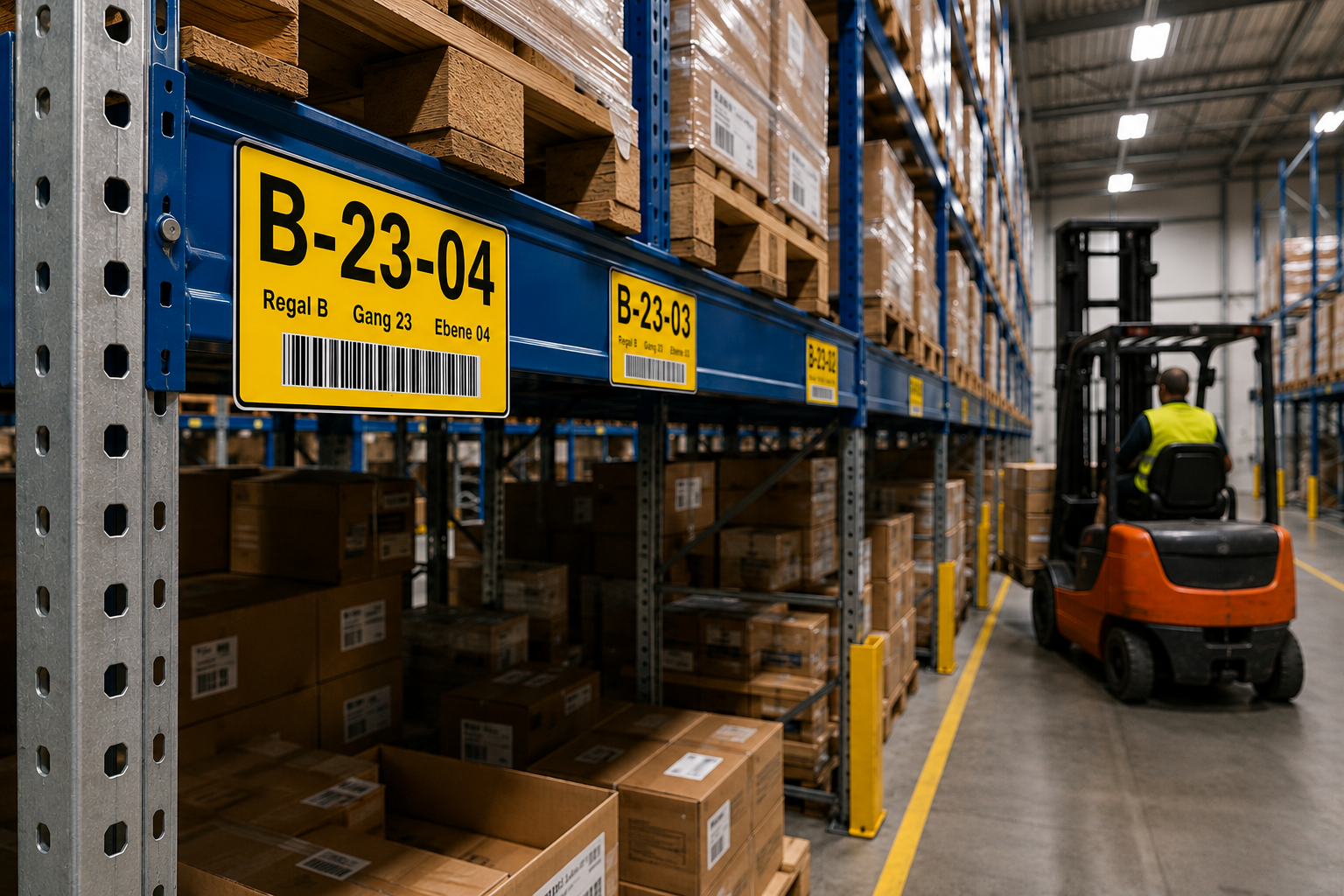
Quick Guide: How to Reduce Throughput Times with Shelf Labeling in 7 Steps
- Analyze the Current Situation: Systematically track current search times and material flows in your warehouse.
- Define a labeling system: Choose a standardized system using numbers, letters, or color codes.
- Structure storage location assignment: Assign a unique identifier to every shelf, container, and storage location.
- Select materials: Choose durable labels—ORGATEX offers forklift-resistant solutions for industrial environments.
- Plan label placement: Attach labels at eye level and within scanner range.
- Train employees: Educate your team on the new system and its benefits.
- Establish monitoring and maintenance: Check labels regularly and replace damaged ones immediately.
How to Reduce Warehouse Throughput Times with Standardized Shelf Labeling
1. Analyze the current situation
Before you optimize your labeling system, you need a clear overview of the current material flow. Measure how long it takes your employees, on average, to locate items.
Also document waiting times between process steps. A material flow analysis reveals where time is lost—often in areas that go unnoticed in day-to-day operations.
Experts show that such analyses can reduce throughput times by 20 to 50 percent, often without major investments.
2. Establish a labeling system
A well-designed labeling system forms the foundation for quick access. You can choose between alphanumeric codes (such as A1, B2), color codes, or a combination of both.
Alphanumeric systems enable structured organization and quick identification. Color codes, on the other hand, provide visual cues that your team can grasp immediately.
Keep the codes short and memorable. Four to six characters per storage location is ideal. That way, no one will ever get lost in the warehouse again.
3. Structure Storage Location Assignment
Assign each storage location a unique identifier that includes the aisle, shelf, and level. Start numbering from the front of the warehouse and work your way systematically toward the back.
Place fast-moving items in easily accessible zones. This strategy reduces walking distances and noticeably speeds up order picking.
Leave gaps in your numbering system for future expansions. This allows you to add new shelf spaces without having to reorganize the entire system.
4. Select Materials
Choosing the right label material is crucial for the longevity of your labeling system. BOPP or vinyl labels are suitable for humid environments. For cold storage areas, opt for polypropylene.
For industrial environments with forklift traffic, you’ll need particularly robust solutions. Floor markings must withstand high mechanical stress.
Removable labels offer flexibility for frequent rearrangements. Permanent markings last longer in fixed storage locations.
5. Plan Label Placement
Place labels where your employees can see them immediately as part of their workflow. The optimal position is at eye level or slightly above.
Use large, bold fonts and high-contrast color combinations such as black on yellow. This ensures the markings remain legible even from several meters away.
In high-ceilinged warehouses, hanging signs mounted at an angle offer an alternative. These are more visible from below and are not worn down by forklifts.
6. Train Your Employees
A labeling system only works if your team understands and uses it. Explain the logic behind the codes and demonstrate how quickly items can be located using them.
With a clear system, new employees learn much faster where specific items are stored. This shortens the training period and reduces errors right from the start.
Gather feedback and adjust the system as needed. Your employees know the processes best.
7. Establish Monitoring and Maintenance
Check your labels at least once a month for damage or fading. Illegible labels lead to wasted time searching and errors.
Replace damaged labels immediately. A small investment of time in maintenance saves many hours in the long run when searching for items.
Document changes to the system and inform your team about them. This ensures that order is maintained over the long term.
What role does the 5S methodology play in warehouse labeling?
The 5S methodology from Lean Management provides a proven framework for implementing labeling systems. It comprises the steps of Sorting, Organizing, Cleaning, Standardizing, and Self-Discipline.
In the context of warehouse labeling, organizing means that every item is assigned a fixed location. The labeling makes this location visible and traceable to everyone.
Standardization ensures that your labeling system is applied consistently throughout the entire warehouse. Without this step, isolated solutions arise that hinder the flow of materials.
How does traceability improve inventory accuracy?
Unambiguous storage location labeling forms the basis for seamless traceability. Every item can be assigned to a specific storage location—from goods receipt to shipping.
This transparency significantly reduces inventory discrepancies. When your employees always put items away and retrieve them from the correct location, physical and digital inventory levels match.
In the event of product recalls or quality inspections, you can quickly and reliably locate affected batches. This minimizes risks and speeds up response times.
How ORGATEX Supports You in Optimizing Your Warehouse Labeling
ORGATEX has been developing field-proven labeling solutions for production and logistics for over 50 years. As the European market leader in Visual Lean Management, we understand the requirements of industrial environments.
Our forklift-resistant floor markings, with an adhesive strength of 27 N/cm, withstand even the most intense use. Magnetic signs and hanging labels round out the product range to meet flexible requirements.
We aim for nothing less than shaping the future of intralogistics together with you. Meet us at one of the many trade shows and let’s discuss your requirements and goals in person.
FAQs on Warehouse Marking Systems
How quickly does a professional labeling system pay for itself?
The investment often pays for itself within a few months. Reduced search times and fewer picking errors lead to a measurable increase in your team’s productivity. ORGATEX supports you in the planning process with free consultation.
Which labeling method is suitable for cold storage areas?
Polypropylene labels have proven effective in environments with significant temperature fluctuations. They remain legible even at sub-zero temperatures and adhere reliably. ORGATEX offers specialized solutions for these requirements.
How do I integrate labels into my warehouse management system?
Barcoded labels can be linked directly to your software. When scanned, the storage location is automatically recorded and posted. ORGATEX manufactures labels according to your individual system requirements.
How often should I check shelf labels for damage?
A monthly inspection is sufficient in most warehouses. In areas subject to heavy mechanical stress, shorter intervals are recommended. You should replace damaged labels immediately.
What is the difference between magnetic and self-adhesive labels?
Magnetic solutions allow for quick repositioning without leaving residue. Self-adhesive labels adhere more permanently and are therefore suitable for fixed storage locations. ORGATEX can advise you on which option is best suited to your specific application.