
Key Takeaways: Station Systems in Production Logistics
- Station systems organize the material flow according to the FIFO principle and ensure a synchronized supply to production stations.
- With visual labeling and clear routing, you reduce search times and prevent incorrect parts from being picked on the production line.
- ORGATEX offers modular station systems that can be flexibly adapted to different container sizes and production environments.
- Implementing a station system reduces inventory, minimizes handling effort, and eases the workload on your production line workers.
- Transparent fill levels enable demand-driven replenishment control and prevent bottlenecks at staging areas.
What is a station system in intralogistics?
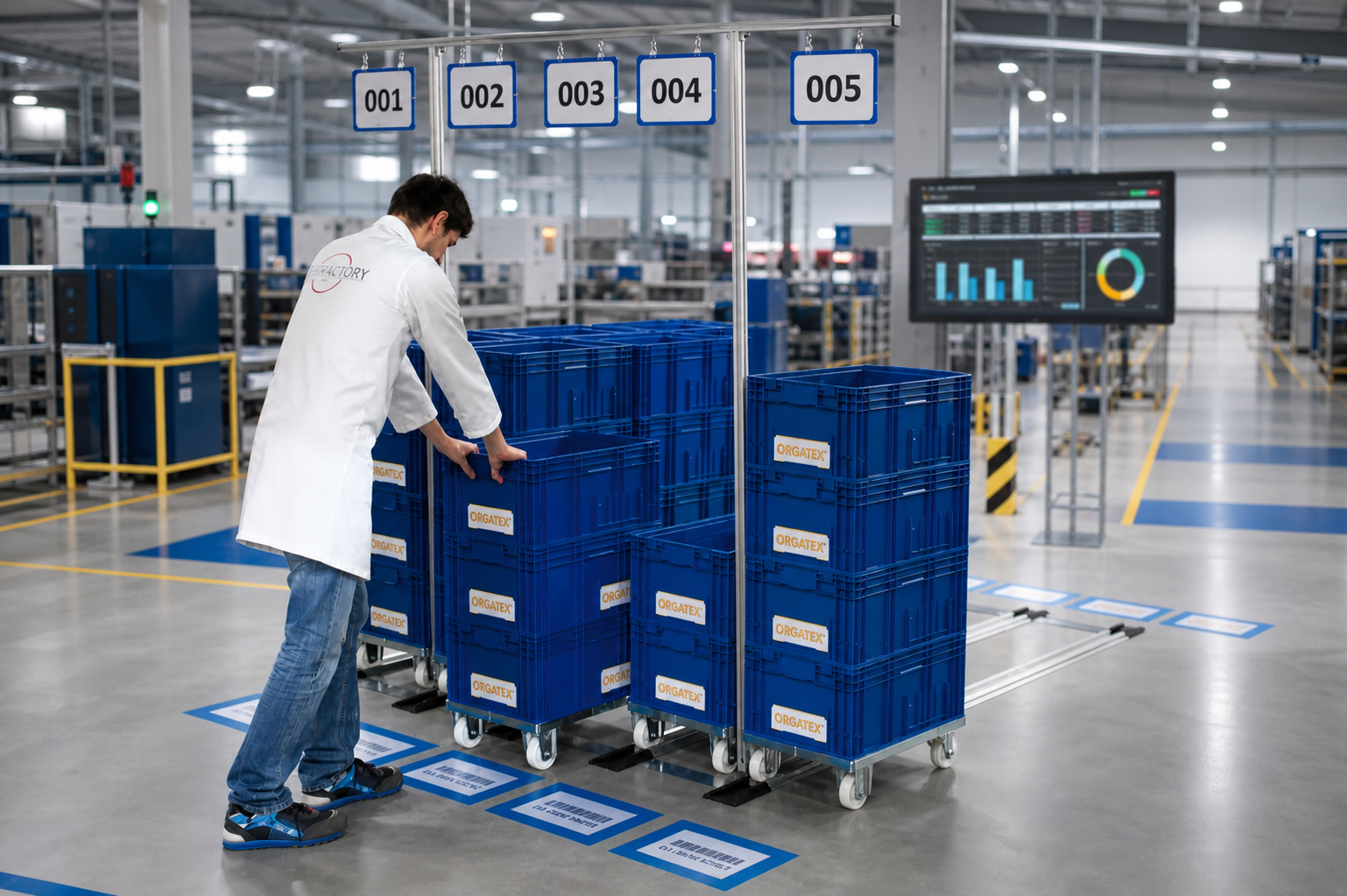
A station system—often referred to as a “supermarket”—is a central staging area in the material flow. Here, parts and components are stored according to the “first in, first out” (FIFO) principle and passed on to the production stations.
It functions similarly to a flow rack: materials are fed in on one side and removed on the opposite side. Stock levels are visible at all times, allowing logistics personnel to replenish supplies with pinpoint accuracy.
For lean managers and production supervisors, this means their workers can focus on value creation without having to worry about material provision.
How does the FIFO principle work at production stations?
The FIFO principle ensures that materials delivered first are also used first. In the station system, this order is guaranteed by the physical arrangement of the tracks.
Materials are loaded from one side and unloaded from the other. This ensures that no material remains in the system for an unnecessarily long time. This reduces the risk of obsolescence, damage, and quality issues.
In the event of material issues, the FIFO principle enables seamless traceability. You can quickly determine which batch a defective part comes from and take targeted action.
What advantages do station systems offer for production control?
Station systems improve production control on multiple levels. Here’s an overview of the key benefits:
- Reduction of inventory: Thanks to the synchronized supply, large buffer stocks at the production stations are no longer necessary.
- Minimization of handling: Workers have direct access to pre-picked materials, eliminating search times.
- Increased process reliability: Standardized procedures and visual labeling prevent incorrect assembly.
- Transparent material supply: Stock levels are immediately visible, and bottlenecks are identified early on.
These factors not only reduce the workload on your production stations but also improve collaboration between logistics and manufacturing.
How does visual labeling support material flow management?
The labeling of individual lanes is a core component of functioning station systems. Each lane receives a unique label that identifies the material and its destination station.
ORGATEX relies on standardized signage systems that provide guidance during both loading and unloading. Incorrect loading is prevented, and workplace safety is enhanced.
Visual aids such as color coding, pictograms, and label panels support the Kanban system and enable quick assessment of the current material status.
Which station system variants are suitable for different applications?
Depending on the container type, roller diameter, and production environment, different system variants are used:
FiFo Monorail Station
The monorail system guides floor rollers along tracks that are 40 mm or 55 mm wide. The flexible design allows for future expansions. An integrated brush brake prevents containers from rolling out on their own and increases operational safety.
Rail System for All Track Widths
In this system, profiles are bonded directly to the floor. The rollers of the floor-mounted trolleys touch the floor; flattened edges and high-visibility colors minimize the risk of tripping. This system is suitable for nearly all roller-guided material carriers.
Both variants can be expanded with information panels, enclosures, and height restrictions.
How do station systems reduce bottlenecks on the production line?
Bottlenecks often arise from uncoordinated material deliveries or a lack of transparency regarding inventory levels. Station systems solve this problem through synchronized supply.
The logistics specialist can see at a glance which lanes need to be restocked. Deliveries follow a fixed schedule—similar to a route train system in public transportation.
The stable, production-synchronized material supply is determined by the production cycle. Defined delivery timeframes enable planning and prevent downtime.
What should you keep in mind during implementation?
A successful implementation of station systems requires careful planning. The following points are crucial:
- Analysis of the current material flow: Where do wait times occur? Which parts are frequently needed?
- Definition of cycle times: How often must materials be delivered to the production station?
- Selection of the appropriate system components: What container sizes and floor rollers are in use?
- Training employees: Logistics staff and production workers must understand the system and be able to use it.
With over 50 years of practical experience in intralogistics, ORGATEX supports you in the design and implementation of your system. From material flow analysis to installation, you’ll receive consultative guidance based on a partnership approach.
How does a rail-based system improve workplace safety?
Workplace safety is a central aspect of modern production environments. Rail-based systems contribute to a safe working environment in several ways.
Standardized material supply reduces uncontrolled vehicle movements in the production area. Less forklift traffic means a lower risk of accidents for staff.
Design features such as flattened rail edges, high-visibility colors, and brush brakes prevent tripping accidents and the unintentional rolling of floor trolleys into traffic lanes.
Conclusion: Sustainably optimize material flow with rail-based material handling systems
Station systems are a proven tool for relieving pressure on production stations and structuring material flow management. They create transparency, reduce inventory, and improve process reliability.
For lean managers and logistics professionals, they offer the opportunity to reduce bottlenecks and take production control to a new level. The modular design allows for flexible adaptation to changing requirements.
Would you like to learn how ORGATEX designs your station system? Meet us at one of our many trade shows or schedule a free consultation at +49 2173 10640 50.
FAQs on Station Systems in Production
What is the difference between a “station system” and a “supermarket” in logistics?
The terms are often used interchangeably. Both refer to a central staging area that operates according to the FIFO principle. The term “supermarket” emphasizes the aspect of self-service by the worker, while “station system” highlights structured routing.
What container sizes are ORGATEX station systems suitable for?
ORGATEX offers modular systems that can be adapted to various container sizes. From small load carriers to Euro pallets, you’ll find suitable solutions. The rail systems are designed for different roller diameters and track widths.
How can a station system be integrated into existing Kanban processes?
Station systems complement Kanban processes perfectly. The visual marking of the tracks corresponds to the Kanban cards, and the fill levels signal the need for replenishment. ORGATEX signage systems enable seamless integration into your existing Kanban system.
What role does the brush brake play in the monorail system?
The brush brake prevents floor trolleys from rolling out of the station on their own. The resistance is generated automatically—without the need for manual unlocking when removing the trolleys. This enhances workplace safety and prevents uncontrolled movements in the production area.
How quickly does the investment in a station system pay for itself?
The payback period depends on factors such as production volume, current inventory levels, and search times. Many companies report inventory reductions of 20–30% and significantly shorter lead times. ORGATEX can assist you with a customized profitability analysis.