
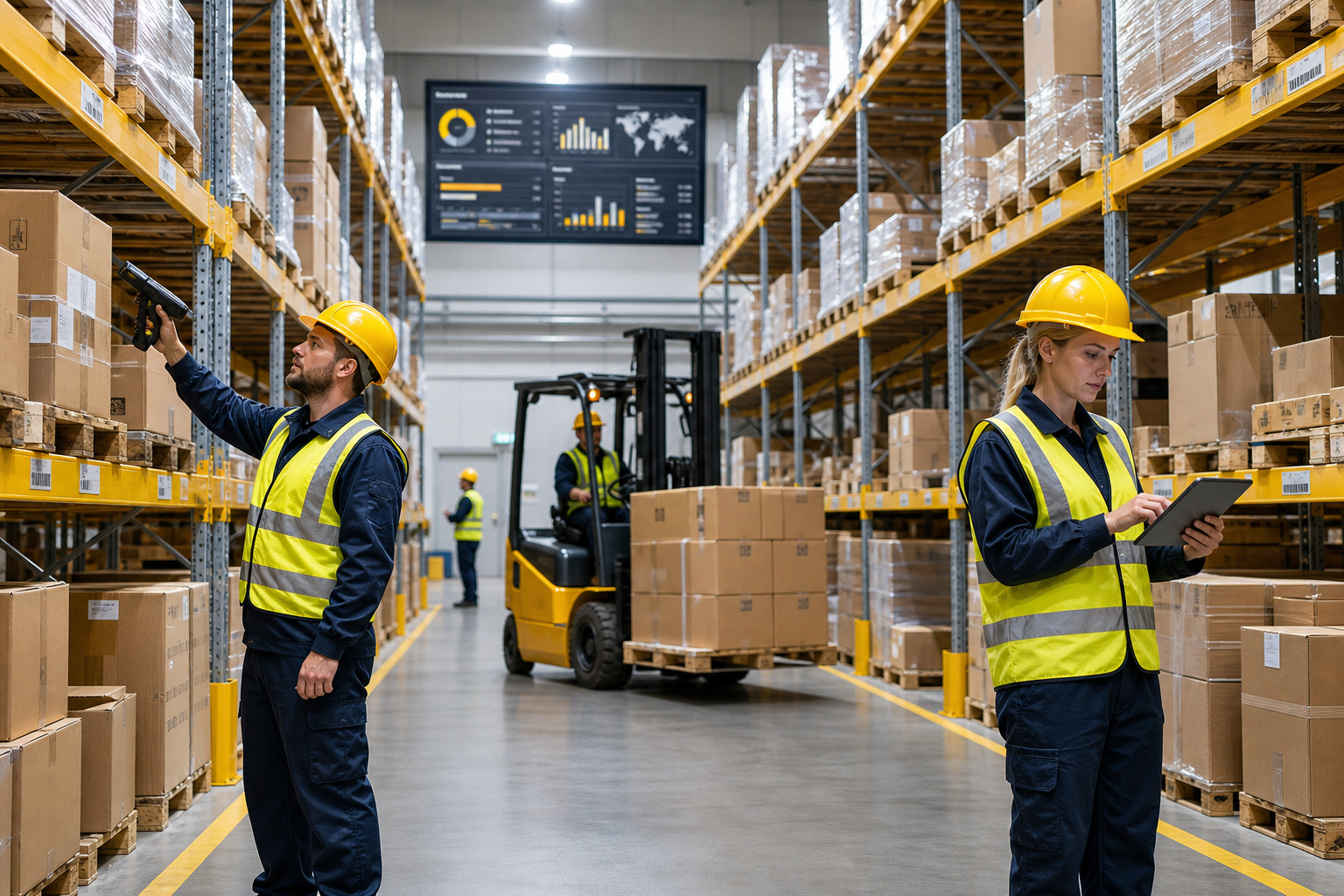
What Are Manual Processes in Intralogistics?
Manual processes refer to workflows in which information is recorded, transferred, or checked by hand. In digital intralogistics, this means that employees visually check inventory, record withdrawals on paper, or report restocking needs verbally.
Typical examples include manually counting Kanban containers, handwriting documentation of goods movements, or visually inspecting shelf compartments. These activities tie up valuable work time and create sources of error.
Why do manual processes cause media breaks?
A data discontinuity occurs when information is transferred between different systems or formats. When a warehouse worker fills out a withdrawal slip that a colleague later enters into an ERP system, there is an interruption in the data flow.
Each of these handoff points carries the risk of transmission errors, delays, and duplicate work. The result: information is no longer up to date, and decisions are based on outdated data.
According to an article in Factory Innovation, digital connectivity can eliminate these data disconnects and enable end-to-end control of material flows.
What delays do paper-based processes cause?
Paper-based processes slow down the material flow at several points. If replenishment needs aren’t communicated until the next shift handoff, waiting times result. Finished parts pile up because the forklift operator wasn’t informed.
These delays add up. Production lines fall out of sync, safety stock levels must be increased, and the ability to respond to customer orders decreases.
In lean manufacturing, this is particularly problematic: the flow principle, which aims for uninterrupted value chains, cannot be maintained this way.
How does a lack of transparency affect lean manufacturing?
Lean manufacturing relies on transparency. Without real-time data on inventory levels and order status, the foundation for informed decisions is missing. Logistics managers and production supervisors work based on assumptions rather than facts.
This has concrete consequences: Material shortages are not noticed until the production line comes to a standstill. Excess inventory ties up capital and warehouse space. Lean principles such as pull control and demand-driven replenishment cannot be implemented without up-to-date data.
What role do search times play in production logistics?
Search times are among the most common types of waste in production logistics. When no one knows where a container is, the search begins. Material carriers disappear between production and the warehouse.
This time is lost that could be spent on value-adding activities. Even more serious: The search throws entire lines off rhythm and causes stress among employees.
Digital tracking technologies such as ORGATEX’s OX-Label make the locations of load carriers and materials visible in real time. Searching is eliminated, and the material flow remains stable.
How can digital solutions replace manual checks?
Digital sensors take over tasks that previously required manual visual inspections. The OX Kanban sensor from ORGATEX detects fill levels contactlessly and automatically triggers replenishment processes.
Here’s how it works: When a container is removed, the sensor reports this to the ORGATEX Cloud. There, a replenishment order is generated and forwarded to the logistics team.
Inventory accuracy increases to up to 99.5 percent. Stockouts drop to less than one percent. Employees can focus on value-added activities instead of checking shelves.
What are the benefits of combining Lean and digitalization?
Lean methods and digital technologies pursue similar goals: reducing waste, stabilizing processes, and increasing responsiveness. Combining both approaches amplifies these effects.
Lean lays the foundation through standardization and the reduction of complexity. Digital systems build on this foundation and enable even finer-grained control. A Kanban system becomes more robust when sensors track container removals in real time.
Visual management is supplemented by dashboards that transparently display key metrics such as lead times and on-time delivery rates.
How do you get started with process automation?
The first step is to take stock: Where are media breaks occurring today? Which manual tasks tie up the most resources? Where is transparency lacking?
ORGATEX supports you in this analysis with a free Gemba Walk. Together with you, our experts identify opportunities directly on-site in your production facility.
Implementation takes place in stages. Individual sensors can be retrofitted within minutes. This leads to quick wins that boost acceptance and motivation within the team.
Conclusion: Replace manual processes with targeted digital solutions
Manual processes remain a hindrance to digital intralogistics as long as they create media breaks and prevent transparency. The good news: The transition doesn’t have to be part of a large-scale project.
With retrofittable sensors and cloud-based control systems, you can target the areas where the greatest inefficiencies occur today. ORGATEX partners with you to help shape the future of your intralogistics.
FAQs About Manual Processes in Digital Intralogistics
What are media breaks in intralogistics?
Media breaks occur when information is transferred between different systems or formats. Typical examples include handwritten notes that are later digitized.
These transfer points create sources of error and delays. ORGATEX eliminates such breaks through end-to-end digital capture using OX sensors.
Why are manual inventory checks problematic?
Manual checks provide only snapshots and are prone to errors. By the time the next check is performed, inventory levels may have changed without anyone being notified.
With the OX Kanban sensor, ORGATEX offers contactless, real-time level measurement that completely replaces manual visual inspections.
How does ORGATEX support the digitization of Kanban processes?
ORGATEX digitizes Kanban processes using sensors that automatically detect container removals. Replenishment is triggered without manual intervention.
The ORGATEX Cloud visualizes all fill levels in real time and provides interfaces to ERP and WMS systems.
What savings are possible through process automation?
Companies report a 15 to 25 percent reduction in labor costs through the automation of manual tasks. Picking errors decrease by 50 to 70 percent.
Efficiency gains range from 20 to 30 percent, leading to higher resource utilization and measurable profit increases.
How quickly can digital intralogistics solutions be implemented?
ORGATEX’s OX sensors are designed as plug-and-play modules. Retrofitting existing racks takes just a few minutes without any wiring or IT integration.
Thanks to the cloud connection, data becomes available immediately. Initial results are visible after just a few days of operation.