
Key Takeaways: Challenges in Digital Intralogistics
- A lack of standardization in interfaces complicates the integration of different systems and causes unnecessary friction in the material flow.
- Data discontinuities between analog and digital processes lead to transmission errors, increased search times, and inefficient workflows.
- System integration often fails due to proprietary solutions that cannot communicate with one another.
- With the eOX Cloud and networked sensor systems, ORGATEX offers solutions that specifically overcome these hurdles.
- Those who systematically address these challenges lay the foundation for transparent and efficient material flows.
Why is digital intralogistics stalling in many companies?
The digitization of intralogistics promises greater efficiency, more transparency, and optimized material flows. In practice, however, many industrial companies struggle with hurdles that slow progress. Three key problem areas are at the center of this: a lack of standardization, poor system integration, and persistent data silos.
For logistics and production managers, this means that instead of a seamless digital material flow, isolated solutions emerge that complicate day-to-day operations. This article highlights where the biggest stumbling blocks lie and how you can systematically overcome them.
Lack of Standardization: When Systems Don’t Speak the Same Language
Automated guided vehicles, warehouse management software, ERP systems, and sensor technology often come from different manufacturers. The problem: Each vendor uses its own data formats and communication protocols. Without uniform standards, siloed solutions emerge that can only communicate with one another through time-consuming customizations.
The German Logistics Association (BVL) points out that standardized interfaces such as VDA 5050 are a key building block for networking. Such open data structures enable the vendor-independent integration of various systems into a central control system.
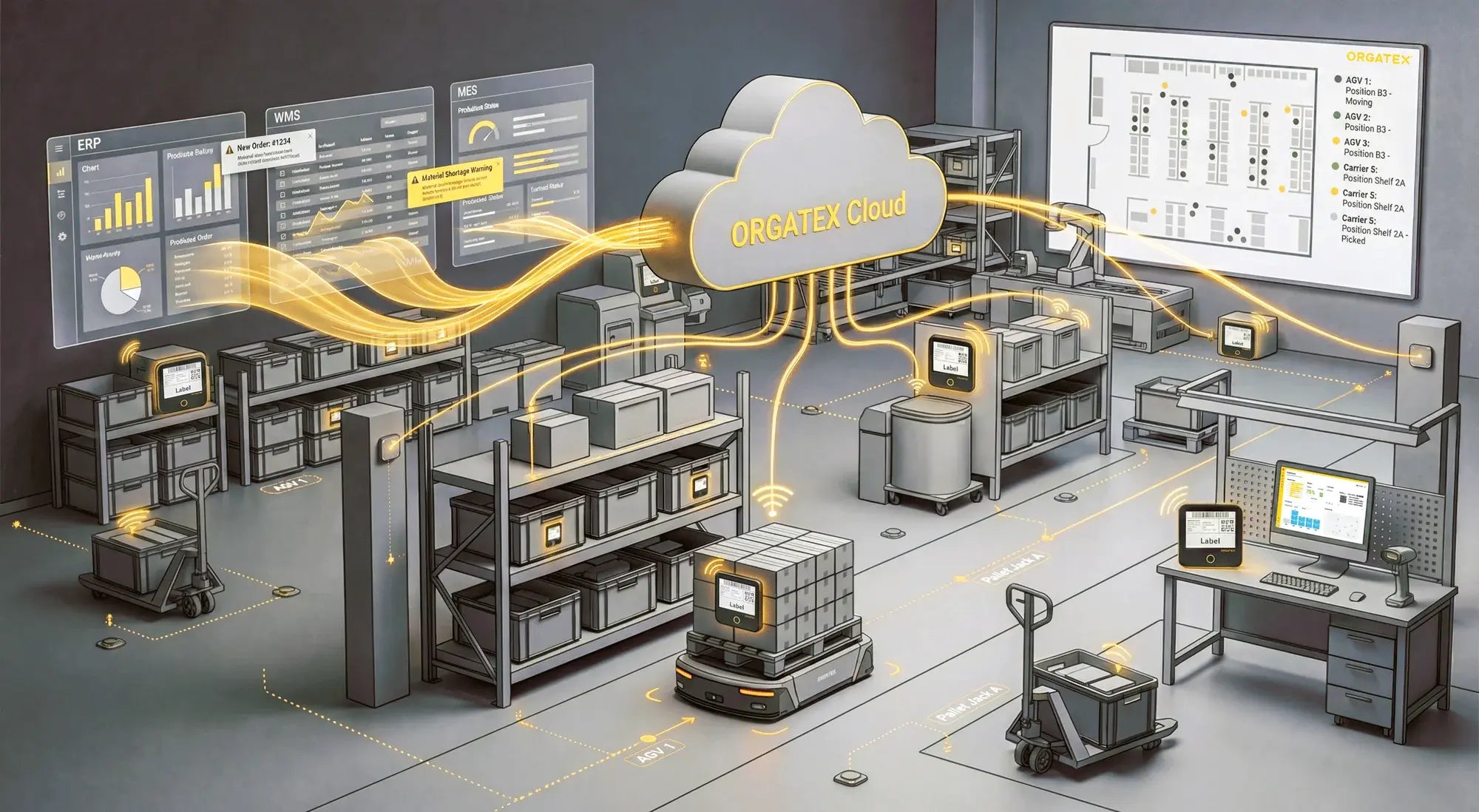
ORGATEX relies on modern architecture with Thread mesh networks and NB-IoT for digital intralogistics. These technologies enable connection to existing IT infrastructures via defined interfaces to ERP, WMS, and automation systems.
System Integration: The Underestimated Hurdle on the Shop Floor
Poor integration of IT systems leads to data inconsistencies, communication problems, and inefficient processes. When automated systems are not integrated into the existing IT landscape, compatibility issues arise and staff are burdened with additional work.
The situation becomes particularly critical when companies run different software solutions in parallel that are not linked to one another. The result: data is transferred manually between systems, sources of error multiply, and the big picture is lost.
What Defines Successful Integration
End-to-end system architectures connect stationary warehouse systems, conveyor technology, and mobile transport systems into a single integrated system. The ORGATEX Cloud enables exactly that: sensor data is captured in real time, visualized, and processed for automated control processes.
What matters is not the largest solution, but the right one. Modular systems that can be expanded step by step are often more sustainable than fully automated turnkey systems, which quickly reach their limits.
Media Breaks: The Hidden Efficiency Killer
A media break occurs whenever information must be transferred from one medium to another. The classic example: order data is received digitally, then printed out for production, documented on paper by workers, and finally re-entered manually into the system.
With each of these transfer steps, the risk of errors, delays, and data loss increases. Media breaks are a sure sign of unstructured and inefficient processes. They lead to:
- Increased processing times due to a lack of integration
- Poor data quality due to manual transfer errors
- Compliance risks due to fragmented and outdated data management
How to Eliminate Media Breaks
The key lies in end-to-end continuity: Data should flow seamlessly—from goods receipt through production to shipping—without any manual intermediate steps. With the OX-Label, ORGATEX offers a solution that combines labeling, tracking, and process data in a single system.
Instead of paper lists and visual inspections, Kanban sensors automatically record inventory levels and trigger replenishment processes. This not only reduces sources of error but also relieves staff of monotonous monitoring tasks.
Paper-Based Processes as a Roadblock
Despite advancing digitalization, many companies still operate with hybrid systems: manual handoffs, paper lists, and unconnected software solutions. These paper-based processes cause unnecessary errors, delays, and a high coordination burden.
According to industry reports, prices for standard components in intralogistics have been falling significantly for years, while computing power and connectivity continue to increase. Plug-and-play solutions can now be integrated in just a few weeks without requiring extensive modifications or operational downtime.
The effort is usually limited to software integration and brief training sessions. This makes digitalization affordable even for medium-sized companies and makes the transition to digital intralogistics a realistic prospect.
Maintenance and IT Security: Often Neglected Factors
Automated systems require regular maintenance and servicing to ensure smooth operation. Underestimating the importance of these tasks leads to downtime and operational disruptions.
Furthermore, intralogistics automation systems are often connected to the internet to transmit and process data. Neglecting IT security can lead to vulnerabilities that could be exploited from outside the network. Modern encryption and role-based access controls are therefore essential.
The Path to End-to-End Digitalization
The challenges mentioned affect many companies but are solvable. Those who recognize them and address them in a structured manner will not only become more efficient but also more resilient to change. The first step: an honest assessment of current processes.
With over 50 years of experience, ORGATEX supports companies on this journey. A free on-site Gemba Walk helps identify potential areas for improvement and develop concrete actions. Together with you, we’re shaping the future of intralogistics.
FAQs: Challenges of Digital Intralogistics
What is meant by a lack of standardization in intralogistics?
A lack of standardization means that different systems and devices from various manufacturers cannot communicate via uniform interfaces. ORGATEX relies on open architectures and defined interfaces to ERP and WMS systems to overcome this hurdle.
How do media breaks occur in the material flow?
Media breaks occur when information is transferred between different media, such as from a digital order to a paper document and back into the system. With ORGATEX’s OX-Label, labeling, tracking, and process data are recorded digitally throughout the entire process.
Why is system integration so important for digital intralogistics?
Without integration, systems operate in isolation from one another, leading to data inconsistencies and additional effort. The ORGATEX Cloud connects sensor data with existing IT systems and enables automated control processes from a central platform.
What role do paper-based processes play in these challenges?
Paper-based processes require manual data transfer steps that are error-prone and time-consuming. Digital solutions such as ORGATEX’s Kanban sensors eliminate these steps and create seamless information flows.
How can I get started with digital intralogistics in my business?
The first step is to analyze your current processes. ORGATEX offers a free Gemba Walk to identify areas for improvement directly on-site. This creates a solid foundation for step-by-step digitalization.