
Floor Markings in Intralogistics – Requirements for Modern Marking Systems
In modern intralogistics, floor markings are far more than simple visual guides. They form the foundation for safe material flows, efficient processes, and standardized production environments. High-traffic areas with heavy forklift traffic, heavy-duty transport, and constant movement place special demands on marking systems: They must withstand mechanical stress, remain legible over the long term, and integrate cost-effectively into existing production structures.
Modern marking solutions must meet three key requirements: First, mechanical durability against forklift tines, pallet jacks, and heavy-duty traffic. Second, durability under industrial conditions such as humidity, temperature fluctuations, and chemical exposure. Third, flexibility in accommodating layout changes and process adjustments on the shop floor. Choosing the right technology depends on factors such as traffic frequency, facility layout, substrate conditions, and the frequency of changes.
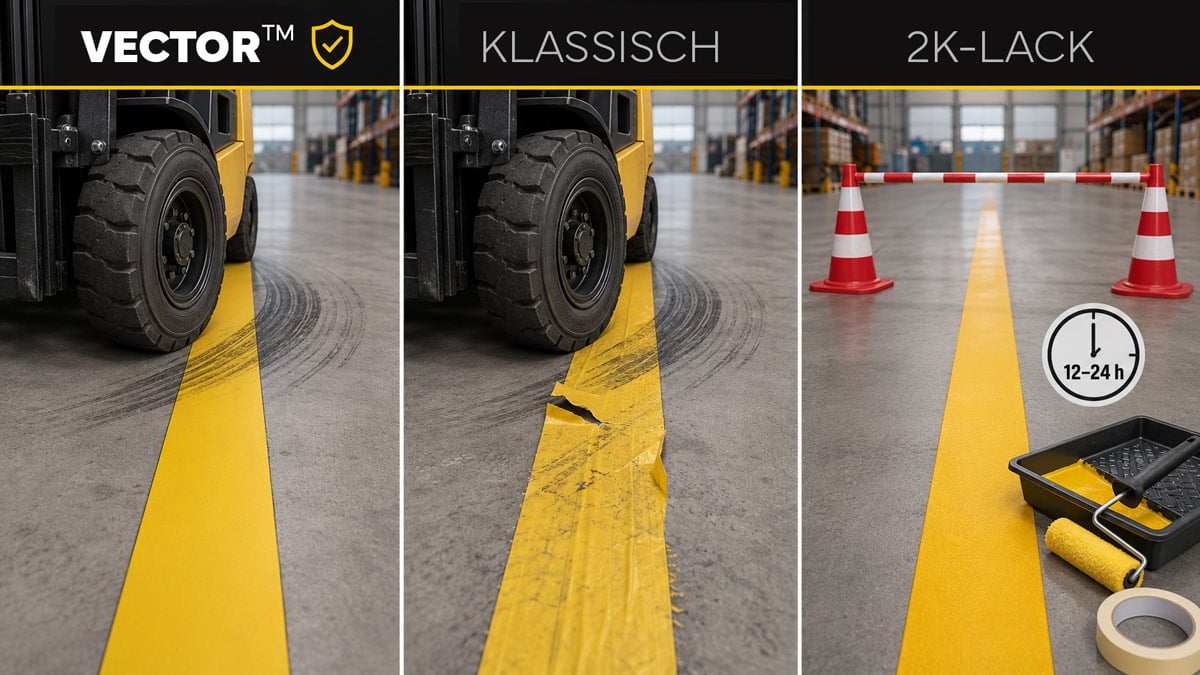
Three established technologies dominate the market for industrial floor markings: Vector™ markings with high-performance adhesion, classic self-adhesive floor markings, and permanent two-component coatings. Each of these solutions has specific strengths and areas of application. The decision in favor of a particular technology should be based on reliable data, specific process requirements, and long-term cost-effectiveness analyses.
Vector™ Technology – Adhesive Strength and Durability for High-Traffic Areas
Vector™ floor markings utilize a proprietary adhesion technology specifically developed for high-traffic industrial areas. With an adhesive strength of 27 N/cm, they offer significantly higher adhesion than conventional self-adhesive markings. This increased adhesion results in improved forklift resistance and reduced peel-off rates, even under intense stress conditions.
The technology is characterized by its resistance to mechanical stress. Vector™ markings withstand constant traffic from industrial trucks, localized stress from pallet jack casters, and the rotational movements of forklift forks. The surface sealant also ensures resistance to oils, cooling lubricants, and cleaning chemicals. In field tests, Vector™ markings achieve service lives that are two to three times longer than those of conventional solutions.
Their use is particularly recommended in areas with high forklift traffic, such as order-picking zones, loading docks, and main traffic routes. Installation takes place without interrupting production and without curing times—a decisive advantage over paint coatings. Layout changes can be implemented by repositioning the markings, and proper removal ensures that no residue is left behind. For production environments that require a combination of flexibility and durability, Vector™ offers a well-balanced solution.
Traditional Floor Markings – Flexibility and Applications on the Shop Floor
Traditional self-adhesive floor markings remain the most commonly used marking solution in production and logistics environments. Their key advantage lies in the combination of immediate applicability, high flexibility, and comparatively low acquisition costs. Installation requires no special tools or skilled personnel and takes minutes rather than hours.
Standard floor markings have a service life of 12 to 24 months under moderate traffic conditions. In areas with occasional forklift traffic, pedestrian zones, or low-traffic warehouse areas, they meet all requirements for visibility and wayfinding. Their availability in various colors, widths, and formats allows for precise adaptation to 5S systems, Kanban layouts, and safety markings in accordance with ASR A1.3.
The flexibility of traditional markings is particularly evident during frequent layout changes, pilot projects, or temporary markings. Misplacements can be corrected without damaging the substrate. The ability to remove them without leaving residue allows for adjustments without costly floor renovation. For dynamic production environments with changing process structures, traditional floor markings represent a cost-effective basic solution that can be supplemented at any time with higher-quality systems.
Two-Component Coating – Permanent Markings for Maximum Stress
Two-component coatings (2K coating) offer the most durable solution for industrial floor markings. The chemical bond between the coating and the substrate creates a permanent, wear-resistant marking with a service life of 5 to 10 years under extreme conditions. 2K systems achieve a layer hardness and abrasion resistance that self-adhesive solutions simply cannot match.
Application requires specialized personnel and specific environmental conditions. Before coating, floors must be cleaned, degreased, and primed if necessary. Depending on the system, the curing time ranges from 12 to 48 hours, during which the marked area must remain off-limits. These requirements make two-component coatings ideal for scheduled maintenance windows, new construction projects, or complete renovations, but less so for ongoing production environments.
The use of two-component coatings is recommended for permanent traffic routes, safety zones, and areas where the structure cannot be altered. In high-bay warehouses, on main forklift routes, and in areas with heavy-duty traffic, the higher initial costs are offset by minimal maintenance intervals. Cost-effectiveness increases in proportion to the intensity of use and the service life. However, layout changes require labor-intensive removal methods such as grinding or milling—a limitation on flexibility that must be taken into account when making an investment decision.
Decision Criteria for Your Production Environment—Costs, Durability, and Process Requirements
Selecting the optimal floor marking technology requires a systematic evaluation of operating conditions, cost-effectiveness, and process requirements. The key decision criterion is traffic volume: Areas with more than 50 forklift passes per day per marking require high-adhesion systems such as Vector™ or two-component (2K) coatings. Areas with moderate traffic (10 to 50 passes) can be cost-effectively marked using traditional markings.
The cost-effectiveness analysis must take into account acquisition costs, installation expenses, service life, and replacement costs. Vector™ markings are priced between traditional markings and 2K coatings, yet achieve service lives that significantly exceed those of traditional solutions. Assuming a doubling of service life, the additional costs of 30 to 50 percent are offset after just two replacement cycles. Two-component coatings require the highest initial investment but result in the lowest life-cycle costs in permanent, high-traffic areas.
Process requirements significantly influence the choice of technology. Production environments with frequent layout changes benefit from the flexibility of self-adhesive systems. Areas with defined, long-term stable structures justify permanent 2K solutions. Hybrid approaches combine both philosophies: main traffic routes are coated, while flexible work areas are equipped with self-adhesive systems. This differentiation optimizes both investment costs and operational flexibility.
The nature of the substrate is another decision-making criterion. Concrete floors with surface sealing are suitable for all three technologies. Porous or uneven substrates require two-component coatings with a primer. Outdoor asphalt floors require specialized adhesives or coating formulations. Investing in a thorough needs analysis prevents costly mistakes and ensures the long-term reliability of your marking systems.