
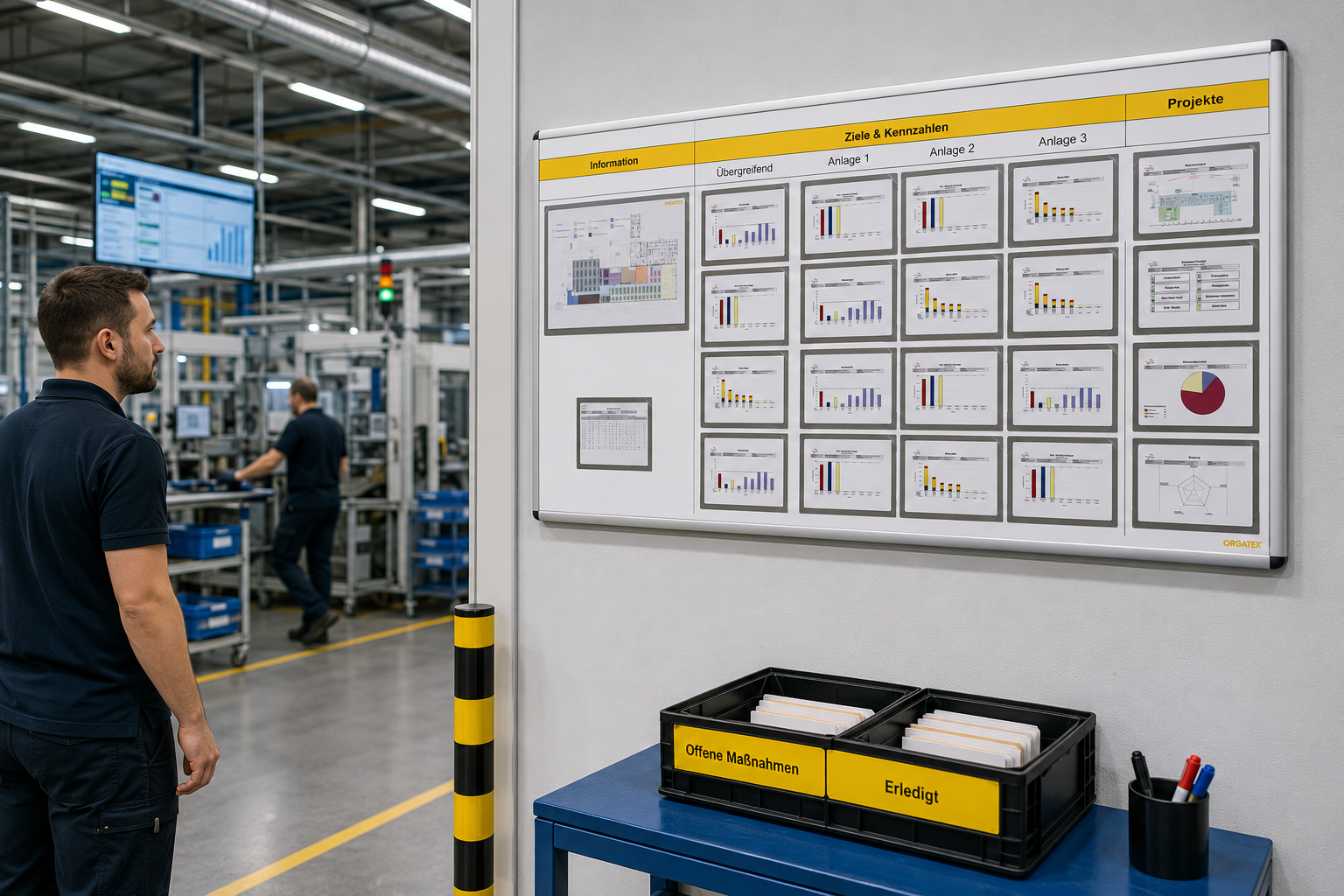
Why Shift Handoffs in Production and Logistics Often Fail
Every day, production teams lose valuable minutes due to unclear information handoffs during shift changes. What happened during the morning shift often reaches the afternoon shift only in fragments. ORGATEX supports you with visual management boards to close these information gaps and make your shop floor processes more transparent.
This guide shows you how to use visual management boards for structured shift handoffs, KPI-based control, and sustainable process discipline in your production and logistics areas. You’ll learn what elements an effective board contains, how to avoid common mistakes, and what advantages the combination of analog and digital solutions offers.
Key Takeaways: Visual Management Boards on the Shop Floor
- Visual management boards make key performance indicators, deviations, and corrective actions visible and traceable for all shifts.
- A clear board structure with SQCD dimensions significantly reduces information loss during shift handoffs.
- ORGATEX Visual Boards allow you to customize them to your specific production and logistics processes.
- The combination of key metric visualization and action tracking fosters a culture of process discipline within the team.
- Regular updates and team involvement are crucial for the long-term success of your visual management boards.
What is a visual management board on the shop floor?
A visual management board is a central communication tool at the point of value creation. It visualizes the most important information regarding key performance indicators, deviations, and ongoing actions for a defined production or logistics area.
The board serves as an anchor point for daily meetings, shift handoffs, and structured problem-solving. It provides transparency regarding the current status and enables quick responses to bottlenecks or quality issues.
Unlike static posters or digital dashboards in the office, the visual management board is located right where the work takes place. This proximity to the action makes it an effective tool for operational control.
What functions does a visual management board fulfill during shift handoffs?
The shift handoff is one of the most critical moments in day-to-day production. Information must be conveyed completely and clearly in just a few minutes. A visual management board structures this process and ensures that no relevant details are lost.
Standardized Information Transfer Between Shifts
The board defines what information is communicated during each handoff. Instead of relying on verbal reports, everyone involved can see the documented status at a glance. The outgoing shift updates the relevant fields, and the incoming shift uses these as a starting point.
Typical elements for the shift handoff include the production status for the past few hours, outstanding malfunctions or quality issues, ongoing actions with assigned responsibilities, and special notes for the next shift.
Documentation of Deviations and Actions
Problems that arise during a shift must not simply disappear when the shift ends. The visual management board permanently documents deviations and makes the resolution status visible. Each action is assigned a person in charge and a target date.
This structured documentation prevents problems from remaining “under the radar” or being addressed multiple times due to a lack of communication between shifts.
How do you structure a visual management board for shop floor control?
The structure of your board determines how effectively it supports day-to-day control. An overloaded board loses its function just as much as one with too little information.
The SQCD Dimensions as a Basic Structure
The proven SQCD structure divides the board into four core areas: Safety, Quality, Cost, and Delivery. These dimensions cover the essential aspects of shop floor performance.
Depending on the company, additional categories may be added. Many companies include a “People” dimension for topics such as training, attendance, or suggestions for improvement. Others integrate environmental and energy metrics.
Structure of the Individual Metrics Sections
Each dimension on the board typically contains three elements: a clearly defined metric with a target value, the current actual status compared to the target, and a visual indication of deviation, such as through color coding.
Green indicates that the metric is within the target range. Yellow indicates a trend toward deviation that requires attention. Red indicates a critical deviation that requires immediate action.
Integration of Actions and Responsibilities
An effective visual management board shows not only the current status but also the path to improvement. For each identified deviation, a specific action should be defined. This action requires a clearly designated person in charge, a target date, and a visible status update.
ORGATEX Visual Boards offer flexible surfaces where you can position action cards with magnets and move them as progress is made. This helps you maintain an overview even when multiple activities are running in parallel.
Which metrics belong on a visual management board on the shop floor?
Choosing the right metrics determines how useful your board will be. Too many metrics can be overwhelming; too few don’t provide a complete picture.
Metrics for Safety and Quality
In the area of safety, you track accidents, near-misses, and reported hazards. The number of accident-free days is a commonly used metric that strengthens safety awareness.
Quality metrics typically include the scrap rate, rework rate, or customer complaints. For many production areas, the first-pass yield rate (the percentage of defect-free products on the first run) is a meaningful metric.
Key Metrics for On-Time Delivery and Productivity
On-time delivery shows whether you are meeting your commitments to internal or external customers. Relevant metrics include on-time delivery rates as a percentage, backlogs in unit quantities, or lead times.
Productivity metrics such as Overall Equipment Effectiveness (OEE) or units produced per shift make performance measurable. These metrics should be selected so that the team can directly influence them.
Employee-Related Metrics
The “People” dimension can reflect skill levels, submitted improvement suggestions, or the status of training initiatives. A skills matrix shows at a glance which employees are qualified for which tasks.
Suggestions for improvement and their implementation status highlight the team’s commitment and foster a culture of participation.
How do you conduct effective shop floor meetings using the visual management board?
The board only realizes its full potential through regular, structured meetings. These meetings provide a framework for communication, problem-solving, and tracking actions.
Daily Briefing Sessions at the Board
A daily shop floor meeting typically lasts 10 to 15 minutes. The team gathers in front of the board and systematically reviews each dimension. The focus is on deviations and necessary actions.
This brief, focused discussion replaces long meetings in a conference room. It takes place directly at the point of value creation, where problems are immediately visible and solutions can be implemented quickly.
Roles and Responsibilities in the Meeting
For a structured meeting, you need a facilitator to guide the group through the agenda. This role can rotate among team members, which strengthens participation and a sense of responsibility.
Each person with an open action item briefly reports on its status. The manager uses the meeting to support the team, not to monitor it. The focus is on obstacles that must be eliminated together.
Escalation for Critical Deviations
Not every problem can be solved at the team level. The visual management board highlights the need for escalation. Define clear rules for when an issue should be escalated to the next level of management.
A multi-level system connects the boards at different levels. Issues that cannot be resolved at the team level appear on the board at the next higher level. This ensures that no problem goes unaddressed.
What mistakes should you avoid with visual management boards?
Many visual management boards fail to achieve their intended effect due to avoidable mistakes. Knowing these pitfalls will help you build an effective system from the start.
Outdated or Missing Updates
A board with yesterday’s numbers loses its credibility. Employees get used to ignoring the information if it’s regularly out of date. Define clear responsibilities and schedules for updates.
For analog boards, a rotation system works well, where different team members take turns maintaining the board. This spreads the workload and helps everyone develop an understanding of the importance of up-to-date data.
Overloading the board with too much information
A board that tries to show everything ends up showing nothing at all. If employees need 30 seconds to find the most important information, the board is too complex. Limit yourself to the metrics that the team can actually influence.
Regularly check which elements are actually being used. Metrics that are never discussed in meetings probably don’t belong on the board.
Lack of Team Involvement
A dashboard created by managers for the team without involving the team is rarely accepted. The employees who work with the dashboard every day should be involved in its design.
Ask your team: What information do you need for your daily work? Which deviations do you need to be able to spot immediately? This involvement fosters a sense of ownership and consistent use.
No Link to Actions and Improvements
A status board that merely displays status without a section for actions remains ineffective. It highlights problems but offers no framework for solving them. Every deviation displayed requires a path to improvement.
Ensure that the board not only highlights symptoms but also supports structured problem-solving. The connection between the metric, the deviation, and the action must be clear.
How do visual management boards support process discipline?
Process discipline does not arise from instructions, but from visibility and shared responsibility. Visual management boards create the transparency required for sustainable process stability.
Visualization of Standards and Deviations
The board makes the defined standard visible. Everyone on the team knows which metrics should fall within the target range. Deviations are not hidden but are openly displayed and addressed collaboratively.
This openness changes the culture. Problems are not seen as the failure of individual people, but as shared challenges that require systematic solutions.
Promoting Personal Responsibility
When employees collect data, document actions, and track progress themselves, their sense of responsibility increases. The board becomes a tool for the team, not a control mechanism for management.
ORGATEX Visual Boards are designed to support this active use. Magnetic surfaces, writable areas, and modular elements enable every team member to contribute to the board.
Supporting the 5S Methodology
Visual management boards are a natural component of the 5S methodology. They foster standardization and self-discipline in the workplace. At the same time, they can visualize the status of 5S audits or workplace inspections.
Integrating 5S elements onto the board reinforces the connection between workplace organization and transparent communication. Together, these form the foundation for stable, efficient processes.
What advantages do analog visual management boards offer over digital solutions?
In the debate between analog and digital, there is no blanket “right” or “wrong.” Both options have specific strengths that vary in relevance depending on the context of use.
Immediate Tangibility and Haptic Interaction
A physical board can be touched, written on, and equipped with magnets. This tactile interaction creates a different connection than tapping on a touchscreen. For many teams, moving an action card feels more tangible than clicking in software.
The board’s physical presence in the workplace serves as a constant reminder. It’s always visible, even when no computer is turned on or the network is down.
Independence from IT Infrastructure
Analog boards function without a power supply, network connection, or software updates. In production environments with harsh conditions or limited IT infrastructure, this independence is a significant advantage.
ORGATEX boards are designed for industrial use. Robust materials and durable surfaces ensure reliable performance even under demanding conditions.
Lower barriers to entry and rapid implementation
An analog board can be set up and put into operation within a few hours. It requires no training in software operation, no user management, and no integration into existing IT systems.
This rapid availability enables an iterative approach: Start with a simple board structure, gain experience, and gradually adjust the layout. This flexibility is often more limited with digital systems.
When does it make sense to combine analog and digital visual management boards?
The question isn’t analog or digital, but how the two approaches can best complement each other. Hybrid solutions leverage the strengths of both worlds.
Analog Boards for Direct Team Interaction
At the point of value creation, where teams gather for brief meetings, analog boards offer clear advantages. Direct interaction, jointly identifying problem areas, and physically manipulating elements foster team dynamics.
For daily shop floor meetings and shift handoffs, the physical board often remains the top choice. It’s always available and requires no technical setup.
Digital Complement for Documentation and Analysis
The strength of digital systems lies in the storage, analysis, and cross-location availability of data. Trends over longer periods, comparisons between departments, and the automatic collection of machine data are much easier to implement digitally.
A sensible combination uses analog boards for daily interaction and digital systems for documentation and long-term analysis. Data from the analog board is transferred to a digital system at defined intervals.
ORGATEX as Your Partner for Comprehensive Solutions
ORGATEX offers both high-quality analog visual boards and digital intralogistics solutions with the eOX system. We work with you to develop the combination that best suits your specific requirements.
Whether it’s a freestanding board for shop floor meetings, a wall-mounted board for the production line, or a rotatable Lean Cube for flexible locations—you’ll find the right solution for your needs in the ORGATEX range of visual boards.
How can you successfully implement visual management boards in your operation?
Successfully introducing visual management boards requires more than just purchasing and setting them up. A structured implementation process significantly increases the chances of long-term use.
Select a pilot area and gain experience
Don’t start by rolling them out on all lines at once. Select a pilot area where you can gain experience. Ideally, this is an area with a dedicated team and a manager who actively supports the concept.
During the pilot phase, you’ll determine which metrics are truly relevant, what the optimal board structure looks like, and what adjustments are needed for your specific context.
Involve the team from the start
The employees who will be working with the board on a daily basis should be involved in its design. Organize a workshop where the team can develop the structure together. This involvement fosters acceptance and a sense of ownership.
Work together to clarify: Which metrics are relevant to us? How do we want to structure shift handoffs? Who is responsible for which updates?
Establish Leaders as Role Models
Leadership must lead by example in using the board. When shift supervisors or production managers regularly attend board meetings and use the board to inform their decisions, this signals the importance of the tool.
Managers should support the board, not control it. Their role is to remove obstacles and provide resources for implementing measures.
Regular Review and Adjustment
A visual management board is not a static system. Schedule regular reviews to evaluate the board’s effectiveness. Is the information being used? Are the identified actions leading to improvements?
Adjust the board’s structure if requirements change or if certain elements are not delivering the expected benefits. This flexibility is one of the advantages of the modular ORGATEX Visual Boards.
What Role Do Visual Management Boards Play in Lean Transformation?
Visual management boards are not isolated tools, but rather building blocks of an overarching lean strategy. They support multiple lean principles simultaneously and amplify their impact.
Connection to Kaizen and CIP
The continuous improvement process (CIP) requires visibility. Visual management boards highlight areas for improvement and make the progress of improvement measures transparent.
Improvement suggestions from the team can be recorded and tracked directly on the board. This fosters a culture in which every employee contributes to process optimization.
Support for Kanban Systems
Visual management boards and Kanban systems share the principle of visualization. Kanban controls the flow of materials; the visual management board controls the flow of information. Together, they create the transparency that lean processes require.
ORGATEX offers you both solutions for lean management and products to support your Kanban systems. This integration enables a holistic approach to your shop floor organization.
Foundation for Shop Floor Management
Shop floor management, as a leadership concept, is based on the manager’s presence at the point of value creation. The visual management board serves as the central tool for structured dialogue between leadership and the team.
With over 50 years of experience in the lean industry, ORGATEX supports you in implementing effective shop floor management. From consulting to product selection, we guide you on your path to more stable and efficient processes.
Conclusion: Visual Management Boards as the Foundation for Transparent Shop Floor Control
Visual management boards bring transparency, structure, and process discipline to your production and logistics. They standardize shift handoffs, make key metrics tangible, and create the framework for systematic improvements.
Success depends not only on the board itself, but also on its consistent use by a dedicated team and supportive management. When implemented correctly, visual management boards become the centerpiece of your daily shop floor routines.
Together with ORGATEX, you’ll design the visual management solution that fits your needs. Contact us—we’d be happy to advise you on the possibilities for your company. Call us at +49 2173 10640 50 or visit us at one of the many trade shows to discuss your specific needs.
FAQs About Visual Management Boards on the Shop Floor
How much does it cost to implement a visual management board?
The investment depends on size, features, and customization. ORGATEX offers solutions ranging from compact wall boards to comprehensive freestanding board systems. Contact us for a personalized consultation tailored to your specific needs.
How long does it take to implement a visual management board?
An analog board can be set up and put into operation within a few days. Sustainable integration into daily routines typically takes 4 to 8 weeks until the team consistently uses the board. ORGATEX supports you in a quick and effective implementation.
What size should a visual management board be?
The optimal size depends on the team size and the amount of information. For a team of 10 to 15 people, a board at least 1,500 mm wide is recommended. ORGATEX Visual Boards are available in various sizes and can be expanded modularly.
How often should a visual management board be updated?
Key metrics should be updated at least once per shift, and more frequently for critical metrics. The status of actions is reviewed and adjusted at every shop floor meeting. Regular updates are crucial for the board’s credibility.
Can visual management boards also be used in logistics?
Visual management boards are ideal for logistics areas. They visualize key metrics such as picking performance, shipping accuracy, or inventory coverage. ORGATEX Visual Boards offer you the flexibility to customize the board to your specific logistics processes.
What sets ORGATEX Visual Boards apart from other providers?
ORGATEX Visual Boards combine robust industrial quality with flexible design options. The modular systems can be customized to fit your processes. In addition, we provide practical consulting from experts with over 50 years of experience in lean manufacturing.