
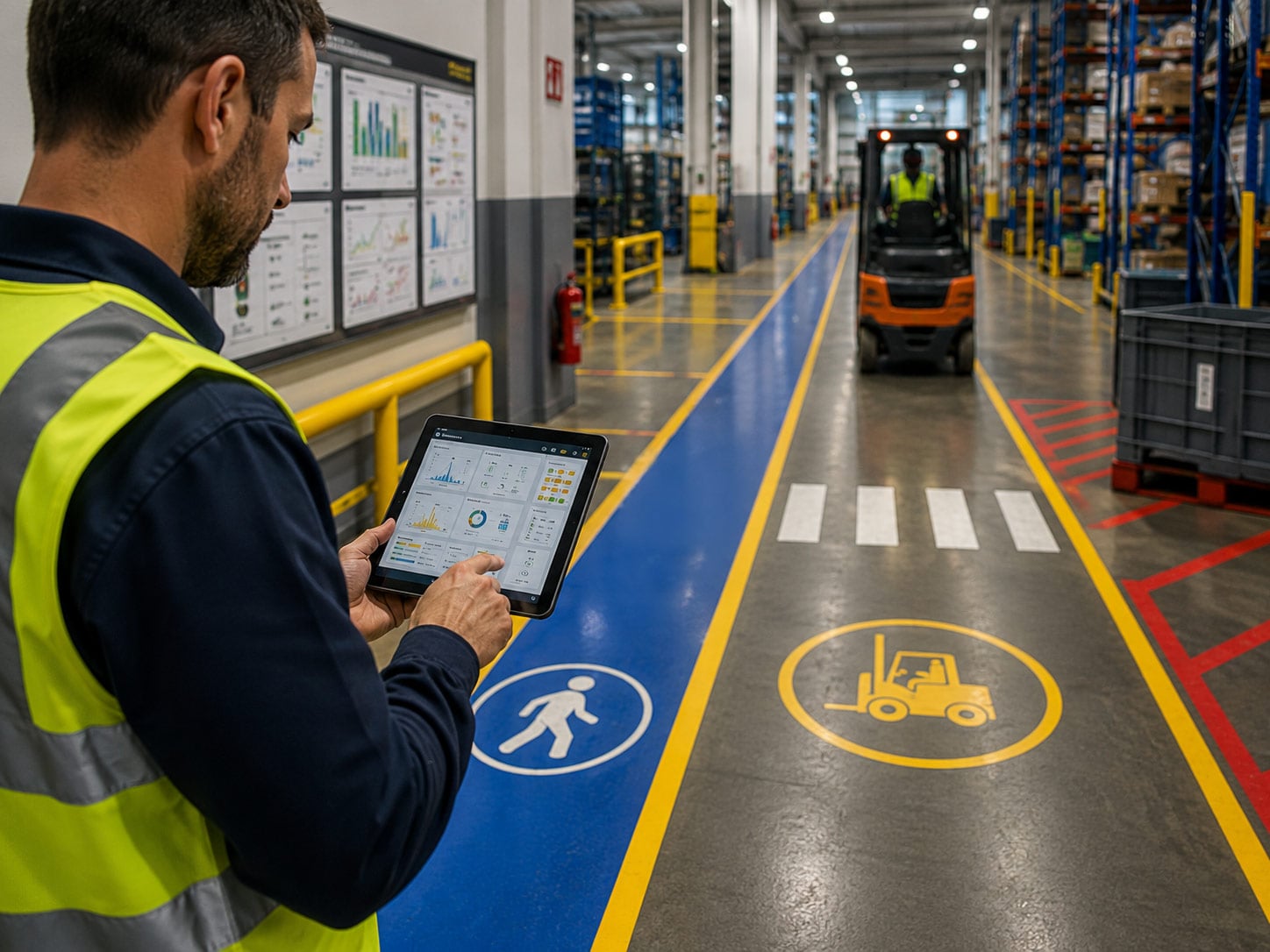
Key Takeaways: Labeling Systems in Manufacturing
- Marking systems help identify safety risks in production early on and prevent accidents through clear visual signals.
- Color-coded floor markings in accordance with ASR A1.3 clearly separate traffic routes, hazard zones, and work areas from one another.
- Global layout standards make it easier for employees to find their way around and speed up the onboarding of new colleagues.
- ORGATEX offers forklift-resistant LongLife floor markings that remain permanently visible even under heavy use.
- Visual management systems reduce search times, increase process reliability, and promote independent decision-making on the shop floor.
What are labeling systems in production?
Marking systems encompass all visual elements that make areas, pathways, and hazard zones visible in production facilities and warehouses. These include floor markings, informational signs, shelf labels, and visual boards.
These systems create a unified language on the shop floor. Every employee can see at a glance where traffic routes are located, which areas are off-limits, and where protective equipment is required.
In complex facilities with multiple shifts, standardized signage provides orientation—regardless of whether someone is new to the company or has been working there for years.
Why do marking systems play a central role in accident prevention?
Thousands of accidents occur annually in production and warehouse facilities in which employees are struck by industrial trucks. Colored floor markings form the foundation for preventing such incidents.
Markings visually separate traffic routes from work areas. When pedestrians and forklift operators use clearly defined zones, the risk of collisions decreases significantly.
In addition, warning and safety markings indicate hazardous areas. Yellow-and-black stripes signal obstacles, while red-and-white markings draw attention to fire safety equipment.
What legal regulations apply to floor markings?
In Germany, several regulations govern the application of floor markings. The Workplace Ordinance (ArbStättV) requires that traffic routes be designed safely.
ASR A1.3 “Safety and Health Protection Markings” defines specific requirements:
- Minimum width of 5 cm for traffic routes
- Marking of traffic routes in yellow or white
- Permanent hazard areas marked with yellow-and-black stripes
- Temporary hazard areas marked with red-and-white stripes
Internationally, ISO 7010 applies to safety signs. In the EU, Directive 92/58/EEC sets forth minimum requirements for workplace signage.
What do the different colors of floor markings mean?
Each color has a defined meaning that employees can understand immediately. Yellow marks traffic routes for vehicles and pedestrians.
Red marks areas for scrap, defective parts, or restricted storage areas. Blue indicates materials awaiting further processing. Green indicates finished products and goods ready for shipment.
Two-color markings serve specific warning functions. Black and yellow signal hazardous areas such as height restrictions or obstacles. White and red indicate fire extinguishing equipment or highly flammable materials.
How do labeling systems support global layout standards?
Companies with multiple locations benefit from standardized labeling systems. When all plants use the same color coding and symbols, employees can work across locations.
Standardized layouts reduce training times. New employees find their way around more quickly because they are already familiar with the visual language from other facilities.
ORGATEX supports the implementation of uniform visual standardswith tried-and-true solutions —from floor markings to visual boards.
What types of signage systems are there?
Floor markings for traffic routes and zones
Floor markings create clear structures on the warehouse floor. They separate vehicle lanes from walkways and define storage zones, parking spaces, and restricted areas.
Forklift-resistant markings withstand the daily wear and tear caused by industrial trucks. ORGATEX LongLife floor markings achieve an adhesive strength of 27 N/cm and remain permanently visible even under heavy use.
Shelf labeling for quick orientation
Shelf labeling enables quick retrieval and safe storage. Customizable systems ensure clear orientation during order picking and restocking.
Visual boards for team communication
Visual boards make planning, performance, and improvement measures visible. They promote transparency and self-directed action within the team.
How do you implement labeling systems in your facility?
Implementation begins with an assessment. First, identify all traffic routes, hazard zones, and work areas in your facility.
Plan the color-coding system in accordance with applicable regulations. Align the system with your internal standards to ensure consistent labeling across all locations.
When implementing the system, follow this approach: First mark the most hazardous areas, then gradually add additional zones. Regular inspections ensure that markings remain visible and intact.
What benefits do marking systems offer for lean management?
Visual management forms the foundation for Lean methods such as 5S and Kanban. When processes are visible, deviations are immediately noticeable.
Clear markings reduce search times. Employees know exactly where materials are stored and which routes to use. This saves time and prevents unnecessary trips.
With over 50 years of practical experience, ORGATEX supports companies in holistically implementing visual management—from analysis to implementation on the shop floor.
Conclusion: Visible standards create safe workplaces
Labeling systems make risks visible before accidents occur. They provide orientation, encourage independent action, and support global layout standards.
Investments in professional labeling pay off through fewer accidents, shorter search times, and more efficient processes. Start with the most critical areas and expand your system step by step.
FAQs on Marking Systems in Production
What is the minimum width required for floor markings on traffic lanes?
According to ASR A1.3, traffic lane markings must be at least 5 cm wide. For better visibility, widths of 7.5 cm or 10 cm are recommended. ORGATEX offers floor markings in various widths that can even withstand being driven over by forklifts.
How long do industrial floor markings last?
Durability depends on the level of traffic and the material used. High-quality, forklift-resistant markings last several years. ORGATEX LongLife floor markings are specially developed for industrial use and can withstand even heavy traffic from industrial trucks.
Do marking systems have to look the same in all companies?
The color scheme for safety markings is defined by law. Beyond that, companies can establish their own internal standards. Consistent systems across all locations make it easier to find your way around and reduce training time.
What advantages do digital marking systems offer?
Digital solutions such as LED projectors complement physical markings. They project lines onto the floor from above and remain visible even when the floor is dirty. ORGATEX combines analog and digital solutions for comprehensive visual management.
How do marking systems support the 5S method?
5S focuses on visual order in the workplace. Floor markings define designated locations for materials and tools. With shelving labels and visual boards from ORGATEX, each area is clearly assigned—this simplifies sorting, systematizing, and standardizing.