
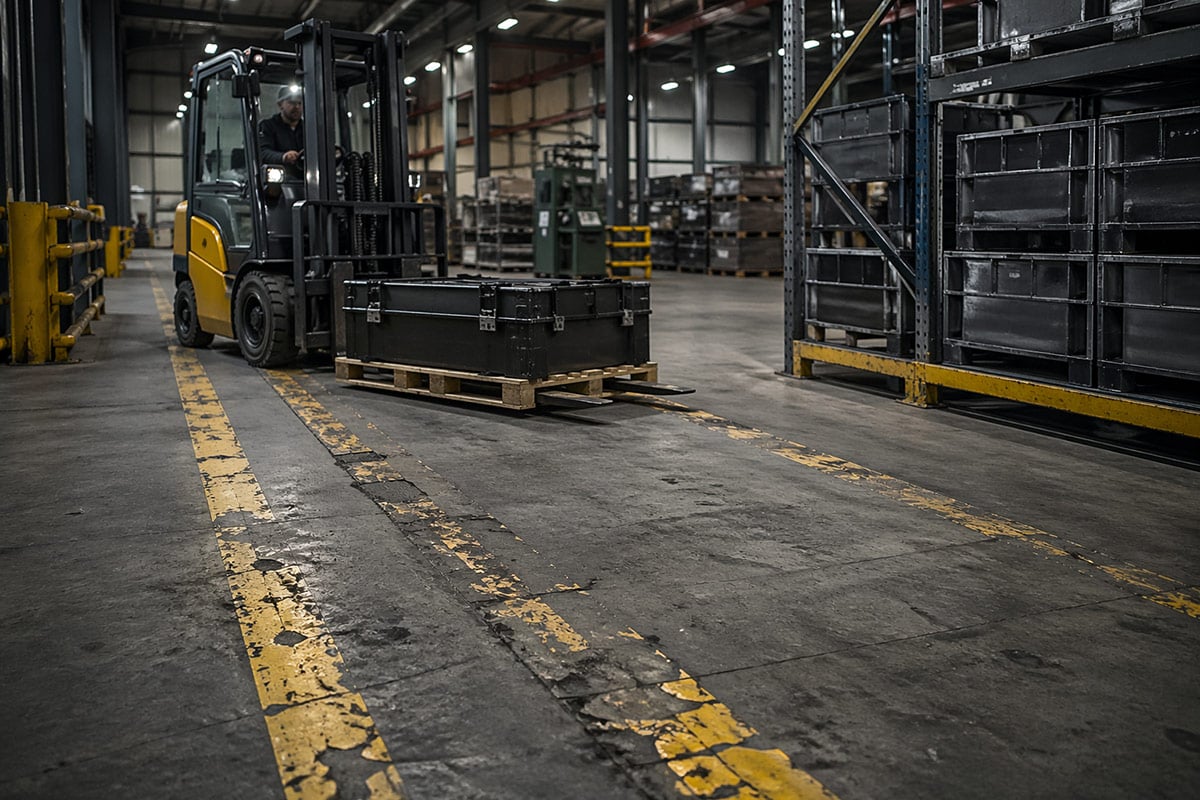
Forklift-resistant floor markings form the foundation for safety and efficiency in production and logistics environments. But why do markings in many plants fail after just a few months? ORGATEX shows you the most common causes of premature wear—and how to prevent them.
As the European market leader in Lean Industry with over 50 years of experience, we understand the practical challenges of forklift traffic firsthand. In this article, you’ll learn which mistakes drastically shorten the lifespan of your floor markings and which solutions really work.
Quick Overview: The 7 Most Common Causes of Floor Marking Failure
- Unsuitable Substrate: When the Floor Does Not Allow for Stable Adhesion
- Inadequate surface preparation: Mistakes made before installation
- Wrong choice of material: When the product isn’t suited for the load
- Torsional forces from rotating forklifts: The underestimated killer
- Aggressive cleaning agents: Chemical stress
- Lack of maintenance intervals: Ignoring wear and tear
- Inappropriate positioning: Markings at critical points
This is how we identified the causes of marking failure
The following analysis is based on decades of experience in production and logistics environments. We have evaluated feedback from hundreds of projects and incorporated the insights of our developers from the ORGATEX Innovation Lab.
- Stress Analysis: What mechanical forces actually act on floor markings?
- Material testing: What properties must a marking have for industrial use?
- Substrate Compatibility: How does the warehouse floor affect adhesion and service life?
- Field observations: What mistakes do we see time and again during on-site inspections?
- Cost Analysis: How do premature replacements affect maintenance costs?
The 7 Most Common Causes of Floor Marking Failure
1. Unsuitable Substrate: When the floor does not allow for stable adhesionDusty, damp, porous, or damaged floors prevent a reliable bond between the marking and the substrate. Even high-quality floor markings do not achieve their full service life on such surfaces and fail significantly sooner under load.
Unsuitable Substrate: Characteristics
- Dusty surface: Fine particles prevent direct contact between the adhesive and the floor
- Moisture in the substrate: Wetness reduces adhesion and promotes premature peeling
- Porous or damaged surfaces: Cracks, spalling, and sandy substrates reduce bond strength
Unsuitable substrate: Advantages and disadvantages
Advantages of a suitable substrate:
- Reliable adhesion of the marking over long periods of time
- Less wear and tear, even under forklift traffic
- Less rework and lower maintenance costs
Disadvantages when the substrate is unsuitable:
- Premature peeling and chipping of the marking
- Uneven adhesion in certain areas
- Increased costs due to frequent repainting
2. Inadequate surface preparation: The most common mistake made before installation
According to field observations, inadequate substrate preparation is one of the main causes of premature failure. Oil, grease, or dust residues on the floor prevent a stable bond between the marking and the substrate.
Optimal preparation includes thorough cleaning, degreasing the surface, and, if necessary, light sanding. Application should take place at a room temperature of approximately 20 °C to ensure full adhesive strength.
Inadequate surface preparation: Characteristics
- Rapid Peeling: Markings begin to peel at the edges after just a few weeks
- Bubbling: Air pockets under the marking lead to instability
- Uneven adhesion: Some areas hold, while others fail
Inadequate surface preparation: Pros and cons
Advantages of proper preparation:
- Significantly longer service life of the marking
- Reduced maintenance costs due to less rework
- Reliable adhesion even under heavy loads
Disadvantages if neglected:
- Premature wear and frequent replacement
- Safety risks due to markings coming loose
- Higher total costs over the service life
3. Incorrect choice of material: When the product is not suited to the load
The choice of material is a key factor in determining durability. An inexpensive adhesive tape designed for pedestrian areas will fail quickly when exposed to forklift traffic.
In logistics and production facilities with regular forklift traffic, durable plastic markings are the right choice. These withstand mechanical stress and remain clearly visible even after intensive use.
Wrong choice of material: Characteristics
- Rapid wear: Lines become illegible after just a few months
- Cracking: Material breaks under pressure
- Deformation: Markings become wavy or warped
Incorrect choice of material: Pros and cons
Advantages of robust materials:
- Longer service life in high-traffic areas
- Better visibility over longer periods
- More cost-effective over the entire life cycle
Disadvantages of unsuitable materials:
- Requires regular replacement
- Production interruptions for re-marking
- Higher overall costs despite a lower purchase price
4. Torsional forces caused by rotating forklifts: The underestimated killer
The most critical moment for floor markings occurs when forklifts turn in place. This generates extreme compressive and torsional forces that literally destroy conventional markings.
This problem is particularly evident at intersections, curves, and turning points—precisely where forklifts frequently maneuver. The consequences: cracks in the material, deformation, and peeling at the edges.
Torsional Forces: Characteristics
- Localized wear: Markings fail in specific spots at pivot points
- Edge delamination: Material peels away from the edge
- Spiral-shaped damage: A typical pattern under torsional stress
Torsional Forces: Advantages and Disadvantages of Various Solutions
Advantages of torsion-resistant markings:
- Significantly longer service life at critical locations
- Reduced maintenance intervals
- Reliable marking even with heavy forklift traffic
Disadvantages of conventional products:
- Fail precisely where markings are most important
- Frequent repairs and production disruptions
- Safety risks due to missing markings
5. Harsh cleaning agents: Underestimating chemical exposure
Cleaning with water, chemicals, or mechanical cleaning machines can significantly shorten the service life of floor markings. Harsh cleaning agents corrode the material and adhesive.
Therefore, the cleaning regimen should always be taken into account when selecting materials. High-quality markings can easily withstand mild cleaning agents—but special products are required in cases of heavy chemical exposure.
Chemical Exposure: Characteristics
- Discoloration: Colors fade or change
- Surface damage: Material becomes brittle or rough
- Loss of adhesion: Adhesion weakens after cleaning
Chemical Exposure: Advantages and Disadvantages
Advantages of chemical-resistant markings:
- Unrestricted cleaning options
- Consistent visibility despite frequent cleaning
- Compatible with hygiene requirements and marking quality
Disadvantages of choosing the wrong product:
- Premature wear due to cleaning processes
- Trade-offs between hygiene and marking durability
- Frequent replacement in cleaned areas
6. Lack of Maintenance Intervals: Ignoring Wear and Tear
Many companies only take action once markings have already become illegible. Regular visual inspections help identify the right time for maintenance measures and avoid major interventions.
The Workplace Ordinance (ArbStättV) requires employers to ensure that traffic routes are designed safely. Faded or damaged markings can not only lead to accidents but also result in legal consequences.
Lack of Maintenance: Signs
- Gradual deterioration: Markings slowly fade
- Partial damage: Individual areas wear out faster
- Complete failure: Entire sections must be replaced
Lack of Maintenance: Pros and Cons
Advantages of regular maintenance:
- Early detection of wear and tear
- Lower costs through targeted repairs
- A consistently safe work environment
Disadvantages of not having a maintenance plan:
- Sudden need for action in the event of acute failure
- Higher costs due to complete replacement
- Potential safety risks and regulatory violations
7. Improper positioning: Markings at critical points
The placement of floor markings significantly affects their service life. Markings located directly at the edges of parking spaces—which are regularly struck by forklift tines or pallets—wear out much faster.
A minimum distance of 30 to 50 mm from the staging area significantly reduces mechanical wear. This measure extends the service life at no additional cost.
Inappropriate Placement: Characteristics
- Localized wear: Damage always occurs in the same places
- Edge damage: Markings tear at transitions
- Mechanical damage: Forklifts or pallets damage markings
Inappropriate Placement: Pros and Cons
Advantages of well-planned placement:
- Longer service life without material changes
- Less wear at critical points
- Lower maintenance costs
Disadvantages of incorrect positioning:
- Premature wear despite high-quality material
- Regular repairs in the same locations
- Unnecessary costs due to preventable damage
What standards apply to floor markings in the industrial sector?
ASR A1.3 specifies the Workplace Ordinance regarding safety markings in German companies. It recommends that traffic lane markings be at least 50 mm wide and preferably white or yellow, with sufficient contrast to the floor.
Black-and-yellow stripes at a 45-degree angle indicate permanent hazard areas, while red-and-white stripes mark temporary hazard areas. The materials should be weather-resistant and able to withstand mechanical stress and moisture.
DIN EN ISO 7010 standardizes safety symbols internationally. Floor signs with pictograms should comply with this standard to ensure consistent and understandable labeling.
How can maintenance costs for floor markings be reduced?
The life-cycle costs of a floor marking include not only the purchase price but also re-marking, production downtime, and labor time for repairs. A low-cost system can end up being expensive if markings regularly chip or peel off.
ORGATEX recommends a comprehensive approach: selecting the right material for the specific application, careful surface preparation, and regular visual inspections. This will help you reduce your maintenance costs in the long term.
During the free ORGATEX Gemba Walk, our experts analyze your situation on-site. You’ll receive concrete recommendations on how to achieve greater safety and efficiency with targeted floor markings—practical and immediately implementable.
Why ORGATEX Offers the Durable Solution for Floor Markings in Forklift Traffic
ORGATEX combines over 50 years of practical experience with in-house product development in Germany. The LongLife product line was developed specifically for the demands of production and logistics and is designed to withstand even the most intense forklift traffic over the long term.
With Vector™ technology, ORGATEX is setting new standards: The world’s first floor marking that withstands rotating forklifts over the long term will be available starting in the summer of 2026. Until then, the proven LongLife products offer reliable markings for your traffic lanes, work areas, and storage spaces.
Would you like to optimize your floor markings and reduce maintenance costs? Schedule a free Gemba Walk with our experts. We’ll analyze your situation on-site and work with you to develop a customized solution—because we shape efficiency together.
FAQs on Floor Markings for Forklift Traffic
Why do floor markings under forklifts wear out so quickly?
The most common causes are inadequate surface preparation, incorrect material selection, and the extreme torsional forces generated when forklifts turn. With its LongLife product line, ORGATEX offers forklift-resistant floor markings that can withstand these stresses.
How often should floor markings in warehouses be inspected?
An annual visual inspection is recommended; in high-traffic areas, inspections should be conducted every six months. Early detection of wear allows for targeted touch-ups instead of costly complete replacements. ORGATEX recommends regular inspections as part of your maintenance strategy.
Which colors are required for industrial floor markings?
ASR A1.3 recommends white or yellow for traffic routes, black and yellow for permanent hazard areas, and red and white for temporary hazard areas. ORGATEX offers floor markings in all standard-compliant colors for safe industrial floor marking.
Can floor markings be removed without leaving any residue?
High-quality self-adhesive markings, such as the ORGATEX LongLife products, can be removed without leaving any residue using the appropriate LongLife Remover. This allows for flexible layout changes without damaging the substrate.
How much does it cost to replace floor markings?
The costs depend on the area, material, and labor involved. However, the key factor is the life-cycle cost: A durable marking with a longer service life is often more cost-effective than inexpensive products that require frequent replacement. ORGATEX will advise you on the optimal solution during a free Gemba Walk.