
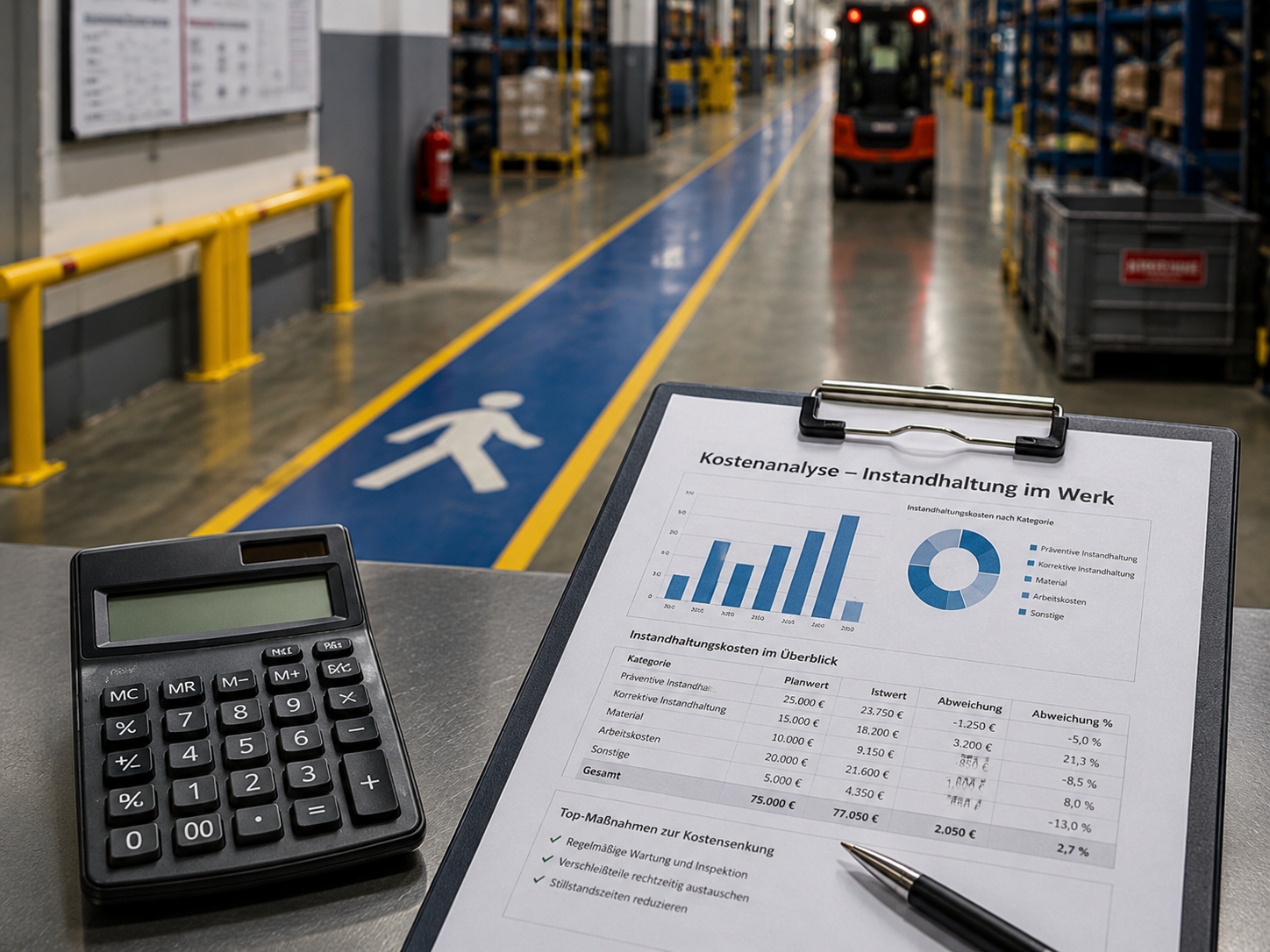
Every year, manufacturing and logistics companies spend substantial amounts on the maintenance and replacement of floor markings. These costs often go unnoticed: new lines here, a touch-up there, plus production downtime and the effort required for coordination. ORGATEX helps you permanently reduce these avoidable expenses through durable floor marking solutions.
In this guide, you’ll learn which factors actually drive up the maintenance costs of your floor markings. You’ll discover how to sustainably optimize your production facilities through the right choice of materials and professional planning. After all, well-designed floor markings aren’t a one-time expense—they’re an investment in your operational efficiency.
Key Takeaways: Floor Markings and Maintenance Costs in the Factory
- Substandard floor markings result in high follow-up costs due to frequent repairs, production interruptions, and material waste.
- Surface preparation plays a key role in determining how long floor markings last and how often touch-ups are needed.
- Forklift traffic, cleaning procedures, and chemical exposure significantly accelerate the wear and tear of markings in industrial facilities.
- ORGATEX floor markings, backed by over 50 years of practical experience, offer high adhesion of 27 N/cm and noticeably reduce your maintenance intervals.
- Proactive planning with zone-specific material selection lowers total costs over the entire life cycle of the marking.
Why Floor Markings Are Hidden Cost Drivers
The direct purchase costs for floor markings account for only a fraction of the actual expenses. The true costs arise over the markings’ service life: re-marking, substrate preparation, downtime, and organizational overhead add up to considerable amounts.
Many companies systematically underestimate these indirect costs. They base their decisions on the purchase price and are later surprised by high maintenance budgets. A low-cost system becomes expensive if markings regularly chip, peel off, or require touch-ups after just a few months.
Particularly critical: Areas must be cordoned off during re-marking. Day-to-day operations are disrupted, material flows are interrupted, and employees must be rerouted. These productivity losses often exceed the pure material costs many times over.
What factors drive up maintenance costs?
Stress from forklift and pallet jack traffic
Forklifts, pallet jacks, and automated guided vehicles (AGVs) subject floor markings to extreme forces. When navigating curves, braking, and accelerating, shear and abrasion forces come into play, destroying low-quality markings within a few months. Intersections, curves, and loading areas are particularly affected.
The level of stress varies greatly depending on the area: A pedestrian zone requires a different system than a forklift aisle. If you don’t take this into account, you’ll either pay too much for oversized solutions or have to pay for touch-ups too often.
Cleaning Methods and Chemical Effects
Harsh cleaning agents, high-pressure washers, and scrubber-dryers take a significant toll on floor markings. In production facilities with high hygiene requirements, floors are cleaned frequently and intensively. Markings must withstand this stress over the long term.
Oil, grease, and chemical residues also corrode many marking materials. In areas subject to such stresses, the choice of material is particularly critical to the markings’ service life.
Inadequate Substrate Preparation
The most common cause of premature wear is not the marking material itself, but the substrate. Dust, dirt, oil or grease residues, residual moisture, and old coatings significantly impair adhesion.
Even high-quality marking systems cannot adhere optimally to poorly prepared surfaces. Investing in thorough surface preparation pays off in the form of significantly longer service life.
Incorrect choice of material for the application
Markings intended for pedestrian areas are often used in forklift zones, or indoor solutions are applied outdoors. Such mistakes lead to heavy abrasion and premature wear.
The result: Markings must be replaced much sooner than necessary. The supposed savings on materials turn into higher overall costs due to more frequent rework.
How Substandard Floor Markings Endanger Your Operations
Unsafe traffic routes due to poor visibility
Worn or faded markings no longer fulfill their function. Traffic routes become unclear, and hazard zones are no longer clearly recognizable. The risk of accidents increases, especially in areas with mixed traffic of pedestrians and forklifts.
The Workplace Ordinance (ArbStättV) and ASR A1.3 require clear marking of traffic routes and hazard zones. Inadequate markings can lead to legal consequences in the event of accidents.
Productivity Losses Due to Frequent Repainting
Every re-marking means cordoning off areas, rerouting traffic, and waiting for drying times. These interruptions add up and hinder productivity. In tightly scheduled logistics processes, such disruptions can result in significant follow-up costs.
Particularly problematic: Touch-ups are often postponed because no suitable time slots are available. The quality of the markings continues to decline until a major renovation becomes unavoidable.
Inefficient use of space due to unclear layouts
Floor markings organize warehouse and production areas. They define storage locations, traffic routes, and work areas. When these structures become blurred, order breaks down. Search times increase, misplacements become more frequent, and the flow of materials stalls.
A clear floor layout is the foundation for efficient processes. Cutting corners here will cost you in productivity later on.
What Sets Durable Floor Markings Apart
High Adhesive Strength and Abrasion Resistance
Adhesive strength determines how well a marking adheres to the substrate. ORGATEX floor markings achieve an adhesive strength of 27 N/cm. This high adhesive strength ensures that markings remain securely in place even under heavy forklift traffic and mechanical stress.
Abrasion resistance describes how well a marking withstands daily wear and tear. High-quality materials remain clearly visible even after months of intensive use and reliably fulfill their function.
Resistance to Chemicals and Cleaning
Durable marking systems withstand contact with oils, greases, cleaning agents, and other chemicals. They resist mechanical cleaning with scrubber-dryers as well as wet cleaning with aggressive agents.
This resistance is particularly important in production environments with high hygiene requirements. The markings must withstand the same cleaning cycles as the floor itself.
Quick and Easy Installation
Self-adhesive floor marking tapes allow for quick application without long drying times. The area can be used again shortly after installation. This minimizes downtime and reduces the overall cost of the marking.
For ongoing operations, this rapid readiness for use is a decisive advantage. Production interruptions remain brief, and operations continue with minimal disruption.
Which marking system is right for which area?
Self-adhesive floor marking tapes
Self-adhesive marking tapes are suitable for many standard applications in industry and logistics. They are versatile, quick to apply, and can be removed if necessary. ORGATEX offers solutions with high durability and resilience.
Particularly suitable for: traffic routes, parking space markings, hazard zone markings, and temporary zones. Installation requires no special equipment and can be easily carried out by in-house teams.
Heavy-Duty Systems for Forklift Zones
In areas with regular forklift traffic, at intersections, and on heavily trafficked pathways, you need robust solutions. Here, the investment in high-quality systems pays off over the course of their service life.
These systems are characterized by exceptionally high adhesion and abrasion resistance. They withstand the mechanical stress caused by heavy vehicles and remain clearly visible even after years of use.
Temporary solutions for flexible areas
Not every area requires permanent markings. Adaptable solutions are available for test layouts, temporary arrangements, or frequently changing areas. These can be applied quickly and removed without leaving any residue.
The combination of permanent main axes and flexible secondary zones often results in the most cost-effective overall solution. This allows you to remain flexible when making layout changes without having to constantly reapply markings.
How to Properly Prepare the Surface
Cleaning and Degreasing
The surface must be thoroughly cleaned before any marking is applied. Dust, dirt, oil, and grease significantly impair adhesion. A clean, dry surface is essential for long-lasting markings.
Use appropriate cleaning agents and allow the floor to dry completely before you begin marking. This preparation takes time, but saves significant touch-up costs in the long run.
Removing Old Markings
Existing markings must be professionally removed before applying new markings. Methods such as shot blasting or milling create a clean base. Residues of old markings impair the adhesion of the new lines.
Removing old markings is an additional step that pays off. On a clean surface, new markings last significantly longer than on reworked old markings.
Assessment of Surface Conditions
Not every surface is suitable for every marking system. Cracks, unevenness, or damaged areas must be repaired before marking. The type of flooring also influences the choice of material.
A site assessment before marking helps prevent future problems. ORGATEX will be happy to advise you on the optimal solution for your specific floor conditions.
Renewing Floor Markings During Normal Operations
Making Strategic Use of Time Windows
Renewing floor markings during ongoing operations requires precise planning. Off-peak hours, shift changes, or scheduled downtime provide windows of opportunity for marking work. Make strategic use of these periods.
Close coordination with operational processes minimizes disruptions. Plan the work so that critical traffic routes are blocked for as short a time as possible.
Implementation in Sections
Instead of marking large areas all at once, it’s recommended to proceed section by section. Each area is completed before the next one begins. This keeps operations running smoothly.
Temporary traffic routing and mobile barriers help maintain the flow of materials during the work. With good organization, re-marking can often be carried out without significant production losses.
Planning Restricted Areas Properly
Restricted zones must be clearly identifiable and divert traffic in a logical manner. Restricted zones that are too large unnecessarily block too much space, while those that are too small jeopardize work safety.
Employees and drivers must be able to immediately recognize which areas are closed off and where traffic is being rerouted. Clear communication is a key factor for success here.
Cost-Benefit Analysis: When High-Quality Markings Pay Off
Calculating Life-Cycle Costs
What matters is not the purchase price, but the total costs over the service life. A high-quality marking with a longer service life can be more cost-effective than an inexpensive solution that needs to be replaced frequently.
Calculate the costs for materials, installation, production downtime, and touch-ups over a period of three to five years. This often paints a clear picture in favor of long-lasting systems.
Take Hidden Costs into Account
In addition to direct material costs, there are hidden costs: personnel expenses for coordination, productivity losses due to restricted access areas, storage costs for replacement materials, and the effort required for documentation.
These indirect costs are often underestimated. When you factor in all these elements, the advantage of long-lasting solutions usually becomes clear.
View Quality as an Investment
High-quality floor markings are an investment in your operational efficiency. They reduce maintenance costs, minimize disruptions, and create permanently safe structures. This reliability has a measurable value.
ORGATEX has been developing solutions for lean manufacturing for over 50 years. This experience is incorporated into products that are up to the demands of everyday industrial operations.
Practical Tips for Successful Marking Planning
Analysis Before Action
First, analyze the area: What types of traffic intersect? Where are safety zones required? Which areas are subject to particularly heavy use? This analysis forms the basis for a coherent marking concept.
Also take future developments into account. If expansions or restructuring are planned, the marking concept should be flexible enough to allow for adjustments.
Zone-Specific Material Selection
Not every area requires the same marking system. Differentiate based on traffic volume: High-traffic forklift lanes require more robust solutions than low-traffic pedestrian zones.
This differentiation saves costs without compromising on quality. You invest more where requirements are higher and optimize where it makes sense.
Documentation and Maintenance Planning
Document marking standards, materials, and installation data. This documentation facilitates future touch-ups and ensures consistent quality. Schedule regular visual inspections to detect wear early on.
Structured maintenance planning extends the service life of your markings. Minor touch-ups at the right time prevent costly renovations.
Regulations for Floor Markings in Industry
Workplace Ordinance and ASR A1.3
The Workplace Ordinance (ArbStättV) and the Technical Rules for Workplaces (ASR A1.3) define requirements for markings in industrial facilities. Traffic routes, hazard zones, and escape routes must be clearly marked.
Compliance with these regulations is not only legally required but also makes good business sense. Clear layouts reduce accidents and increase efficiency. For more information, visit the ORGATEX page on floor markings in industrial facilities.
Color Coding According to Standards
Certain colors have specific meanings: yellow and black for hazard zones, green for escape routes, and white or yellow for traffic routes. Consistent color coding ensures quick orientation and increases safety.
Adhere to established standards. This allows employees from other companies or external service providers to find their way immediately.
How ORGATEX Reduces Your Maintenance Costs
Durable, in-house developed products
ORGATEX develops floor marking solutions with the goal of extending maintenance intervals and reducing maintenance costs. The high adhesive strength of 27 N/cm and resistance to forklift traffic make our markings particularly durable.
As a family-owned company with over 50 years of experience, we understand the demands of production and logistics. This practical expertise is incorporated into every product development.
Consulting and Custom Solutions
Every facility is different. That’s why we offer not only products but also consulting services. Together with you, we analyze your requirements and develop a marking concept that fits your operational processes.
Take advantage of our free consultation at +49 2173 10640 50. We’ll help you find the right solution for your specific situation.
Robust Solutions for Lean Industry
As the European market leader for Lean Industry, ORGATEX offers a comprehensive range of products for Visual Lean Management. Floor markings, storage location labels, and safety markings work together to create structured work environments.
This integration allows you to source all visual elements from a single provider. Consistent quality and coordinated systems simplify planning, procurement, and maintenance.
FAQs on Floor Markings and Maintenance Costs
What are the biggest cost drivers for floor markings?
The biggest cost drivers are frequent touch-ups due to low-quality materials, production interruptions during marking work, and inadequate surface preparation. ORGATEX floor markings with high adhesion reduce these costs through longer service life and lower maintenance requirements.
How long do high-quality floor markings last in industrial settings?
The service life depends on traffic, cleaning, and the substrate. In low-traffic areas, high-quality markings last several years. With heavy forklift traffic, faster wear and tear is to be expected. ORGATEX offers suitable solutions for every traffic level that extend your maintenance intervals.
What are the advantages of self-adhesive floor markings?
Self-adhesive floor markings allow for quick installation without long drying times. The area can be put back into use promptly, minimizing downtime. ORGATEX floor marking tapes combine this flexibility with high durability and resistance to forklift traffic.
How does forklift traffic affect durability?
Forklifts generate high shear and abrasion forces when turning and braking. Inferior markings wear out quickly under this stress. ORGATEX floor markings are specifically designed for these demands and can withstand even heavy forklift traffic over the long term.
Can floor markings be replaced while operations are ongoing?
Renewal during ongoing operations is possible with proper planning. Work in sections, take advantage of off-peak hours, and plan temporary traffic routes. Thanks to their quick installation, ORGATEX self-adhesive markings are particularly well-suited for implementation while production continues.
How much does professional warehouse floor marking cost?
Costs vary depending on the area size, complexity, and the system chosen. However, the total cost over the service life is the decisive factor. ORGATEX offers durable solutions that are more cost-effective than seemingly inexpensive alternatives due to reduced maintenance costs and longer service life.
What standards apply to floor markings in industrial facilities?
The Workplace Ordinance (ArbStättV) and ASR A1.3 define requirements for traffic routes and safety markings. ORGATEX products meet these specifications and help you comply with legal requirements in your production and warehouse areas.