
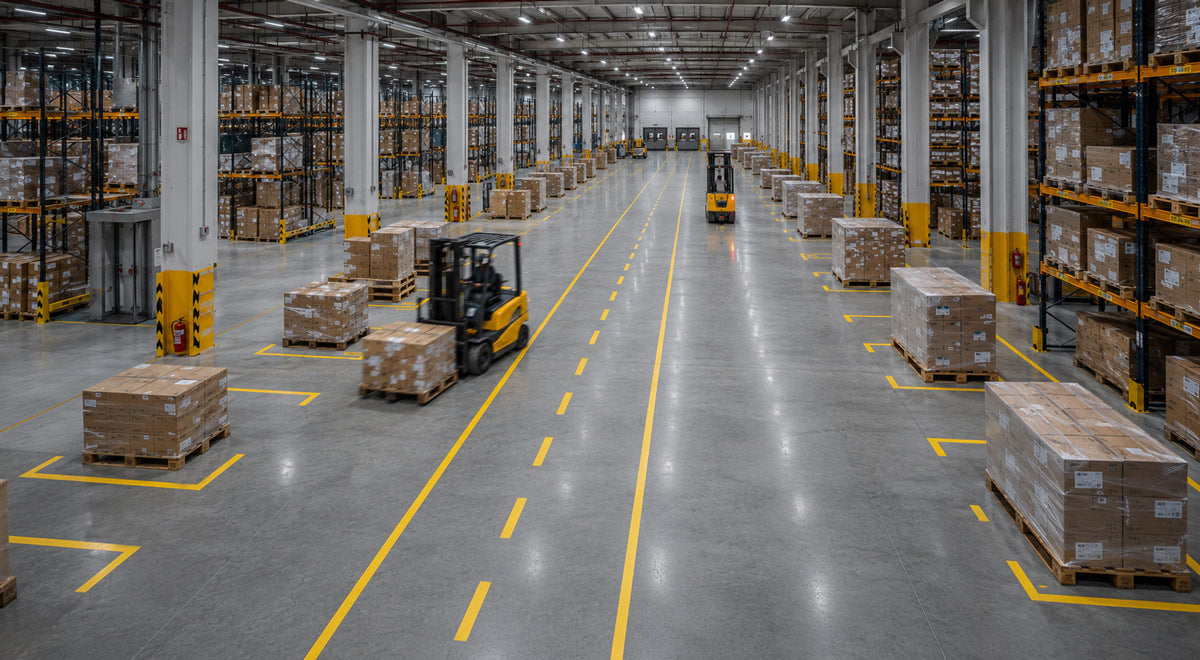
Forklifts, tugger trains, and pedestrians encounter one another daily in confined spaces. The German Social Accident Insurance (DGUV) records thousands of reportable accidents involving internal transport each year. Many of these could have been prevented through consistent floor marking. ORGATEX helps you mark your traffic routes, storage areas, and hazard zones in a way that ensures safety and efficiency go hand in hand.
This guide shows you how to plan floor markings, select the right materials, and comply with legal regulations. You’ll learn which color codes are mandatory, how to ensure audit compliance, and how to sustainably stabilize your material flow.
Key Takeaways: Floor Markings in Industry and Logistics
- ASR A1.3 and ASR A1.8 form the legal foundation for floor markings in German workplaces.
- Yellow-black and red-white stripes are legally required for hazard zones (45° angle of inclination).
- ORGATEX floor markings offer forklift-resistant adhesion of 27 N/cm for permanently visible markings.
- The minimum width for marking lines is 5 cm; in practice, 50 to 100 mm is standard for main traffic routes.
- Regular inspections (at least every six months) document your duty of care toward workers’ compensation associations.
What legal frameworks govern floor markings?
In Germany, there is no single law that deals exclusively with floor markings. The obligation to mark surfaces arises from the interplay of several sets of regulations at different levels.
ASR A1.3 (Safety and Health Protection Markings) defines how hazardous areas must be visually highlighted. ASR A1.8 regulates the dimensions and layout of traffic routes. Both sets of regulations implement the Workplace Ordinance (ArbStättV).
EU Directive 92/58/EEC as the European Framework
The European basis is provided by Directive 92/58/EEC on minimum requirements for safety and health signage in the workplace. It requires all companies in EU member states to mark hazard zones and traffic routes.
In Germany, this directive was transposed into national law through the ArbStättV. Anyone who cuts corners or ignores these regulations not only risks fines during BG inspections but also negligently endangers the health of employees.
DGUV Regulation 9: Requirements for Insurance Coverage
DGUV Regulation 9 (formerly BGV A8) governs the safe operation of vehicles within a facility. Section 13 explicitly requires that traffic lane boundaries be marked in color, be clearly recognizable, be permanent, and be continuous.
Compliance with this regulation is a prerequisite for full insurance coverage by the employers’ liability insurance association in the event of a claim. In the event of workplace accidents, this helps you avoid liability due to organizational negligence.
What do the colors mean in industrial floor markings?
The color scheme is partly defined by standards and partly standardized by industry practice. DIN 4844 and ASR A1.3 provide binding definitions for safety colors.
To ensure that external suppliers or new employees can find their way immediately, a strict color code has been established. This provides language-independent, intuitive orientation within your facility.
Single-color markings and their meanings
Yellow (RAL 1021 Rapeseed Yellow) indicates vehicle lanes, pedestrian walkways, and boundary lines. White (RAL 9016 Traffic White) marks parking spaces for machinery, equipment, and pallets. Red indicates restricted areas, rejected goods, and fire safety equipment.
Green stands for approved zones and safety equipment. Blue indicates finished goods and materials for further processing. Orange marks quarantine zones and materials under inspection.
Two-color warning markings in accordance with ASR A1.3
Yellow-and-black stripes warn of permanent obstacles and hazard areas: edges, pillars in the traffic lane, or crushing hazards. Red-and-white stripes indicate temporary obstacles, restricted zones, and fire safety areas.
The stripes must be arranged at a 45° angle and be of equal width. This distinction is essential so that the brain can properly prioritize hazards.
How wide must traffic routes and marking lines be?
According to ASR A1.3, the minimum width of a marking line is five centimeters. To ensure good visibility even from a distance amid the hectic daily routine of a warehouse, experts recommend a width of 50 to 100 mm for main traffic routes.
This dimensioning ensures that the line continues to fulfill its warning function for a long time even with slight wear and is not immediately overlooked.
Minimum Widths for Pedestrian and Vehicle Paths
A minimum width of 0.875 m generally applies to pedestrian walkways. Forklift aisles must be dimensioned so that there is a safety clearance (edge allowance) of at least 0.50 m on both the left and right sides relative to fixed structural elements.
In the case of oncoming traffic, these requirements increase: Here, the sum of both vehicle widths plus three times 0.50 m serves as a guideline. ASR A1.8 and DGUV Regulation 68 define the specific dimensions.
Which materials are suitable for which warehouse floors?
Choosing the right marking material determines whether the markings will last for years or peel off after just a few weeks. There is no one-size-fits-all solution, as floor conditions, forklift traffic, and cleaning intervals have a massive impact on durability.
1K Floor Marking Paint for Light-Duty Applications
Single-component acrylic paint is the most cost-effective solution for areas with light to medium traffic. Drying time: 30 to 60 minutes at room temperature. Durability: one to three years with moderate forklift traffic.
The drawback: Low abrasion resistance when used with heavy forklifts equipped with solid rubber tires and during turning maneuvers. This material is not suitable for main traffic routes with heavy traffic.
2K floor marking paint for main traffic routes
Two-component systems (epoxy or PU) are the professional choice for heavy forklift traffic. Once cured, they form an extremely durable, chemical-resistant coating with a service life of five to ten years.
The downside: drying times of 12 to 24 hours require production downtime. For facilities with 24/7 production, application is recommended on weekends or during plant shutdowns.
Self-adhesive industrial marking tapes for flexible zones
ORGATEX floor markings, with an adhesive strength of 27 N/cm, are immediately walkable and drivable. They are particularly suitable for areas with frequent layout changes and lean operations that hold regular Kaizen workshops.
The forklift-resistant markings do not come off under normal loads. When layouts change, they can be removed without leaving residue and reapplied. Optimize your internal processes with flexible marking solutions.
Light Projection for Maximum Flexibility
Floor markings created using a ceiling projector are completely wear-free and can be changed as needed. They work even on dusty or uneven floors. Automakers and large logistics service providers are already relying on this technology.
The downside: high investment costs, limited visibility in bright daylight, and unsuitability for outdoor areas. However, for highly flexible picking zones, this solution can be a game-changer.
How do you systematically plan floor markings?
Professional warehouse marking doesn’t start with a can of paint, but with a well-thought-out plan. Safety markings require a systematic approach that takes structural conditions, traffic flows, and operational processes into account equally.
Step 1: Conduct a risk assessment
The starting point for any marking plan is the risk assessment required by Section 5 of the Occupational Safety and Health Act. Identify specific hazard areas: intersections of forklift and pedestrian traffic, blind curves, and areas with limited visibility.
The occupational safety specialist (SiFa) and the company physician should be involved. In the event of an accident, this documentation serves as important evidence for the workers’ compensation association.
Step 2: Create a facility layout and define zones
Create a scale-based facility layout showing all traffic routes, parking areas, work zones, and hazard areas. Assign a color to each zone according to your company’s internal color-coding system.
An important principle for color planning: as few colors as possible, as many as necessary. A system with three to five colors is sufficient for most companies and remains intuitively understandable for all employees.
Step 3: Prepare the Floor
The most common reason for the rapid failure of paint markings is inadequate preparation of the substrate. Concrete floors are often contaminated with dust, oil residues, or tire grit, which act as a barrier layer.
Before application, the floor must be thoroughly cleaned and, ideally, lightly roughened by shot blasting or grinding. For new concrete floors, a minimum curing time of 28 days must be observed.
Step 4: Apply and Check the Markings
For straight lines, use chalk lines or laser line projectors. Marking devices on wheels ensure uniform line widths and clean edges.
After drying, conduct a visual inspection under actual lighting conditions. Markings that are not clearly visible when the facility lighting is on do not serve their purpose.
What common mistakes should you avoid?
A classic mistake in practice is “over-marking” the facility. A jumble of colorful lines and symbols confuses employees rather than guiding them.
Focus on critical traffic routes, intersections, and strictly prohibited zones. Corner markings (L- or T-shaped sections) often serve the same purpose as fully outlined parking spaces. Excessive visual density leads to what is known as “warning blindness.”
Failure to Include Markings in the Maintenance Schedule
It’s often forgotten to include the markings in the regular maintenance schedule. Faded, partially peeled-off, or blackened lines from tire abrasion suggest that safety rules aren’t a priority at the company.
An outdated marking scheme that no longer matches current traffic patterns is, in some cases, more dangerous than no markings at all. It creates a false sense of security and encourages risky shortcuts.
Incorrect Material Selection for the Load
Anyone who wants to save time and cuts the drying time short of the manufacturer’s recommendations risks forklift tires immediately tearing up the fresh paint. Similarly, choosing marking tape for areas with heavy turning traffic leads to rapid failure.
The choice of material must be suited to the mechanical stress involved. Hybrid approaches often make sense: permanent 2K paint for main traffic routes, and high-quality marking tapes from ORGATEX for flexible storage zones.
How do you ensure audit compliance?
Floor markings are subject to constant wear and tear during operation due to forklift traffic, cleaning machines, and mechanical stress. The ASR A1.3 standard requires that safety markings be “clearly recognizable and permanent.”
Faded or damaged markings no longer meet this requirement and must be replaced promptly. Maintenance is an ongoing task that should be incorporated into the company’s maintenance schedule.
Documenting Semiannual Inspections
In practice, a semi-annual inspection schedule has proven effective. The inspection should be conducted by the occupational safety specialist or the designated plant manager and documented.
Check the following: Is the marking visible along its entire length? Are there any areas of wear, peeling, or discoloration? Does the marking scheme still match the current facility layout? This documentation is part of the hazard assessment.
Train Employees on the Color System
All employees and external service providers must be trained on your color system. This training is mandatory under Section 12 of the Occupational Safety and Health Act.
Document the training in writing. This way, in the event of an accident, you can prove that all parties involved were aware of and understood the meaning of the markings.
How do floor markings improve material flow?
Floor markings are much more than just a safety tool. They organize storage areas, define storage locations, and provide visual clarity for everyone involved in the material flow.
Imagine that every container, every pallet, and every tool has a defined, marked location. Deviations from the target state become immediately visible to all employees.
The 5S Method and Visual Management
The systematic use of floor markings for workplace organization has its roots in the Toyota Production System. The 5S Method uses floor markings as a visual management tool.
ORGATEX offers a wide range of products for production and logistics: from forklift-resistant floor markings to hanging signs and Kanban systems. We’ll work with you to design your visual management solution.
Reducing Search Times and Errors
Clear zoning speeds up logistics processes. Employees immediately know where materials should—and should not—be placed. This reduces search times and errors during order picking.
Delineating work areas makes it easier to maintain order in the warehouse and allows work processes to be designed more effectively and safely. Every improvement in material flow has a direct impact on your productivity.
How much do professional floor markings cost?
The cost of complete facility markings depends on the size of the facility, the quality of materials chosen, and whether the work is performed in-house or by a specialized contractor.
For a typical production or warehouse facility with a floor area of 2,000 m², the total cost ranges from 2,800 to 8,000 euros net. The exact cost varies depending on the choice of materials and the method of application.
Return on Investment Through Accident Prevention
Measured against the risk of accidents and the potential liability consequences, the costs are manageable. According to DGUV calculations, a single serious forklift accident causes total costs averaging between 50,000 and 150,000 euros.
This amount includes medical care, lost workdays, an increase in workers’ compensation insurance premiums, and potential recourse claims. Floor markings in a 2,000-m² warehouse therefore pay for themselves if they prevent even a single accident.
What trends are shaping the future of floor markings?
Floor markings are not a one-time project that is completed once the warehouse opens. When logistics processes change, racks are moved, or new industrial trucks are introduced, the safety concept on the floor must evolve accordingly.
Modern technologies are already demonstrating that the future will be more flexible. Projected markings can adapt warning messages to the situation as it unfolds.
Dynamic LED Floor Guidance Systems
In the Netherlands, logistics service providers are experimenting with dynamic LED floor guidance systems that are embedded in the warehouse floor. These systems change their color and line patterns in real time via software.
This technology is still in the pilot phase but could become relevant in German facilities in the coming years. It offers particular potential in highly flexible order-picking and assembly environments.
Digitization of Material Flow
The ORGATEX Innovation Lab is working on the next generation of products that combine analog and digital solutions. The eOX Cloud enables the digitization of your material flows and creates new opportunities for intralogistics.
We want to shape the future of intralogistics together with you. Meet us at one of the many trade shows and let’s discuss your requirements and goals in person.
Conclusion: Floor Markings as the Foundation for Safety and Efficiency
Floor markings are a relatively cost-effective yet highly effective tool for workplace safety management. Those who are familiar with applicable regulations, select the right material for the specific load, and create a clear color scheme can establish order and reduce the risk of accidents.
Investing in high-quality materials and professional preparation pays off in the long run. It minimizes downtime for repairs and ensures that every employee goes home safe and sound at the end of their shift.
A clear line on the floor always reflects a clear line in corporate culture. With over 50 years of experience, ORGATEX supports you in planning and implementing your marking concept. For more application scenarios, visit: www.orgatex.com
FAQs on Floor Markings in Industry and Logistics
What colors are required for floor markings?
Yellow-and-black stripes for permanent obstacles and red-and-white stripes for restricted areas are mandatory under ASR A1.3. For traffic routes, the standard recommends yellow (RAL 1021) or white (RAL 9016).
ORGATEX offers floor markings in all standard-compliant colors, so you can mark your facility clearly and in compliance with legal requirements.
What is the minimum width required for floor markings?
ASR A1.3 stipulates a minimum width of 5 cm. However, for main traffic routes in industrial and logistics settings, experts recommend 50 to 100 mm to ensure visibility even with slight wear.
ORGATEX floor markings are available in various widths to suit your specific requirements.
Which material lasts the longest under forklift traffic?
Two-component paints (epoxy or PU) offer the longest durability—five to ten years—under heavy forklift traffic. High-quality marking tapes with strong adhesive strength last one to three years and offer greater flexibility for layout changes.
ORGATEX floor markings with an adhesive strength of 27 N/cm can withstand the stresses caused by forklifts and automated guided vehicles (AGVs).
Are floor markings mandatory in warehouses?
Yes. Section 13 of DGUV Regulation 9 explicitly requires that traffic lane boundaries be marked in color, be clearly recognizable, be permanent, and be continuous. Without these markings, you risk losing your insurance coverage in the event of an accident.
How often must floor markings be inspected?
A semi-annual inspection schedule has proven effective in practice. The inspection should be performed by a certified occupational safety specialist and documented. Damaged or faded markings must be replaced promptly.
How much does it cost to mark a warehouse?
For a 2,000-m² facility, the costs range from 2,800 to 8,000 euros net. This investment pays for itself if it prevents even a single serious accident, which, according to DGUV calculations, can cost between 50,000 and 150,000 euros.
What advantages do floor markings offer for material flow?
Floor markings organize storage areas, define storage locations, and provide visual clarity. They reduce search times and picking errors by assigning a fixed location to every container and pallet.
ORGATEX supports you with floor markings and Kanban systems to optimize your internal processes and increase the efficiency of your material flow.